
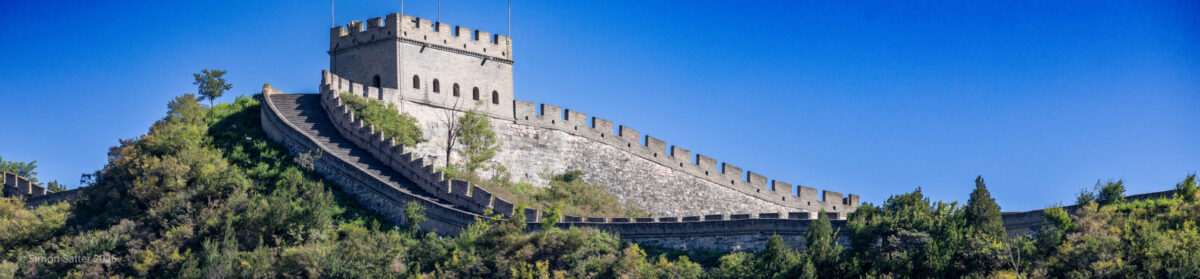
Xian is not only famous for the Terracotta Army but also for its walls and numerous temples and towers. We started our day with a visit to the walls. This was quite fun. Early in the morning before too many people were around. A steep ramp of steps took us to the top of the walls. From here we could peer down on the city waking up underneath us. Some keen early morning joggers were running around the top of the walls. Down below a group of less energetic locals were doing their tai chi and a young girl was posing for photographs. We saw an awful lot of this in China. One or more pretty girls dressed to the nines looking their best for the camera. If you want to get the best effect, you can hire a frock and a photographer.


The day was already starting to get hot as we came down off the walls and clambered into the coach. 40 km east from the city is where the Mausoleum of Qin Shi Huang and his Terracotta Army are located. From the car park we had to walk. Then we had to queue and get through security. Then we had to walk quite a long way before queuing again to go through a passport check. In the normal run of things, a passport is not needed to gain entry to a museum. This is China. You need your passport to catch a train, visit a museum, go on a river cruise, enter a theatre or even visit a garden. I am not just talking about a simple glance at passport type check either. This is a full-on electronic scan. Insert your passport and wait for the light to turn green. Identity, location and time verified with the central database. Somebody is keeping very close tabs on exactly where you are. This is not just for tourists. Everyone needs to carry an electronically scannable identity card.
We still could not get to see the Terracotta Army. First, we needed to run the gauntlet of the Terracotta Army carpet shop. This began with a little workshop where they were making a little Terracotta Army. Souvenir army figurines made with the local clay so they looked a lot like the real thing. After the talk about artisan craftsmen, authenticity and the other usual stuff, we got shown into the Terracotta Army showroom. This contained hundreds, possibly thousands, of Terracotta Army themed souvenirs plus a lot of other stuff that was just touristy and Chinese. Took a while just to find the way out of here and then we were taken off for lunch.


Lunch turned out to be terrible and the day was turning out to be horribly hot and sweaty. So, I was feeling quite grumpy when we finally got to stand in a queue that would get us, at last, to see the Terracotta Army. The sculptures depict the armies of Qin Shi Huang, the first emperor of China. They were buried with him to in his mausoleum with the purpose of protecting him in his afterlife. The figures vary in height according to their rank. Obviously the tallest are the generals. The figures include warriors, chariots and horses. Estimates are of more than 8,000 soldiers, 130 chariots with 520 horses and 150 cavalry horses. Other, non-military terracotta figures have since been found in other pits, including those of officials, acrobats, strongmen, and musicians. The figures were discovered in 1974 by seven farmers digging a well. Shortly after the significance of the find was recognised the site became an archaeological dig, a UNESCO heritage site and a massively lucrative tourist attraction described as the eight wonder of the world.


Our wonderfully politically correct guide, Johnson, explained that the farmers were compensated and re-housed. However, the truth is that their farmland was seized and their houses demolished. The discoverers received almost no financial compensation—initially just one yuan—and many slipped into extreme destitution while the tourism generated immense wealth for officials and businessmen. One of the farmers, Wang Puzhi, committed suicide in 1997 after suffering from extreme poverty and untreated heart disease. Yang Wenhai and Yang Yanxin both died penniless in their 50s from severe illnesses. A few surviving members, such as Yang Zhifa, were later employed at the Emperor Qin’s Terracotta Warriors and Horses Museum gift shop to sit and sign books for tourists for a tiny daily wage.
The army is in three pits. Pit 1 is the largest and holds the greater part of the army. We had to fight to get in. Chinese, we have learned, spend a lot of times in crowds and queuing. They are not only exceptionally good at it but also completely ruthless. We joked that if you stood with your feet apart then someone would slip through between your legs. Sneaking under your arms is commonplace. Pit 1 is a massive, covered area with a walkway down the sides. You enter at one end and exit at the other. Inside, you need to fight to see over the railings as you get carried along towards the exit. It was all very hot, smelly and uncomfortable. Guards are posted everywhere and I was rather startled by the tools on display for managing unruly tourists. A sign proclaimed “No crossing. Violators must be punished”. You have been warned. Punishment is not optional.
Despite all this, the army is quite interesting. Several thousand life-sized figures all facing the same direction. Apparently, when they were first buried, they would have been dressed in standard armour and carrying real weapons. The sheer amount of work needed to create the army gives you an idea of the power that the emperor must have wielded. Right up there on the list of most powerful along with the Pharos of ancient Egypt. In a similar fashion to my first encounter with the pyramids, I was left with a wondering question about who came up with the idea of doing this and why they thought it was the way to go in the afterlife.


After Pit 1 comes Pit 3. A lesser pit with fewer figures in it. Then comes Pit 2 which appears mostly empty but does have some horses. Dotted around all three pits were some indicators that this is still an active archaeological site. However, I did strongly suspect this was more for display than anything else.
Back out in the late afternoon sun we had to find our way back to the coach. This is no easy feat. The route back is long, a kilometre or more, and takes you through an entire village of souvenir shops, food shops and a myriad of other ways of trying to separate money from the tourists.


In the evening, we got the dressing up box out. After dinner everyone was handed robes and we all got dressed up before heading out onto the streets of Xian. This is really not my thing. I tried to go along with it and took a few photographs. Others were much more enthusiastic and set about engaging with some of the locals. At one point we came across a few people dancing on the pavement and everyone joined in. Nearly everyone. I felt my talents were better employed behind the camera.


The streets were crowded with people and well lit. It all made for quite a nice scene although I am not sure what the public thought about our pseudo-Chinese robes. I would like to imagine that they enjoyed us adding some colour and vibrancy to the evening. However, I suspect that some of them just sighed and muttered something about the nature of tourists. It all made for a long day. I was very happy to crawl into my bed.


