Britain’s last war and the official end of the world

Ushuaia is the self-proclaimed official end of the world. Their moto is Ushuaia, fin del mundo, principio de todo (Ushuaia, end of the world, beginning of everything). It is generally recognised as the southernmost city in the world. There are settlements further to the south, such as Porto Williams in Chile, but Ushuaia is only one that can genuinely claim to be a city. Interestingly, in a change since I was last there, Ushuaia also claims to be the capital of the Falklands. In recent years, the assertation that Las Malvinas son Argentinas (The Falklands are Argentinian) is becoming increasingly manifest. Signs and posters abound. There is a memorial park with plaque, statues and an eternal flame. Roads have been renamed. Our hotel was on the Heroes de Malvinas road. The Mirador Heroes de Malvinas is a layby with a pleasant view across the Beagle Chanel. Prominent billboards have been erected at viewpoints so that you can include a Las Malvinas son Argentinas message in your holiday snaps.

Presumably, Argentina is trying to up the ante, again, with regards to its territorial claim over the Falklands. I can’t help thinking that this is a little pointless. Ignoring the fine detail of the relative claims, it is clear that the UK considers its claim more than adequate. This was proven in 1982 when Argentina invaded. They were forcibly ejected a few weeks later by a UK task force. In a recent poll, 99.8% of Falklanders reported that they wanted to remain British. The Falklands is financially self-sufficient and important to the UK with regards to its operations in Antarctica. It is unclear, to me, what Argentina is hoping to achieve. An increase in diplomatic tensions is the only likely outcome and that does not seem beneficial to anyone.

We decided to spend a few days in Ushuaia. It is a interesting place. Last time we had been here we went straight to the airport from the ship. Prior to that, I had spent the best part of a week here but that was 35 years ago. Things have changed massively since then. Back then, although nearly ten years after the Falklands war, there was almost no reference to territorial claims.

We took a short drive into the Tierra del Fuego National Park. This is where the Pan-American Highway officially ends at Lapataia Bay. Here is also the end of the Andes. The vast mountain range tapers into the ocean and then reappears, much further south, as the Trans-Antarctic Mountains. A few ducks and geese accompanied us on a short walk along the edge of the bay. Then the rain started again. Fine for ducks but miserable enough to encourage us to give up and head back Ushuaia.

One of the great tourist trips in Ushuaia is to take a boat out into the Beagle Chanel. It is rich with wildlife including birds, seals and whales. Our boat was a medium sized catamaran called Anna B. It was filled to capacity. 100 people. Barely a spare seat anywhere. The morning was overcast and gloomy. We splashed out on some instant coffee in paper cups from the onboard shop and huddled around our table for a while. Then, thoroughly wrapped up against the cold and damp, we went out on deck.

There were some albatross, giant petrels, shags and dolphin gull. We approached Snipe Island quite closely which gave us an unobstructed view of the shags nesting and the lighthouse. In May, 1958 the Chileans built the first lighthouse here to aid navigation. Argentina, obviously, disputed ownership of the island. The following month, Argentina pulled down the Chilean lighthouse and built one of their own. This only lasted a few weeks before it was demolished and a second Chilean lighthouse erected. Next day, in a fit of pique, the Argentinian destroyer ARA San Juan razed the building with its main guns. They then landed a company of naval infantry to occupy the island and assert their claim.

The dispute simmered for 20 years. In 1978, Argentina developed Operation Soberanía, a plan to invade all the Chilean disputed territories. Chile pre-empted the invasion and placed troops on Snipe and other islands to the south. In 1984 Argentia held a referendum on the disputed territories around the Beagle Channel. The motion to recognise Snipe, Picton, Lennox and Nueva islands as being Chilean territory was carried by an 84% vote. The following year, a treaty was put in place marking the end of disputes over the Beagle Chanel.

We continued east past Peurto Williams and past Isla Gable. On a small spit of land, we spotted a dead whale being enthusiastically recycled by some giant petrels. Further on we came across the steel hulled, three masted barque called Europa. Previously, we had seen this rather lovely ship at the Argentine Islands down on the Antarctic Peninsula.

Our catamaran pulled right into the beach at the east of Isla Gable. There are many seals and penguins here. We spotted Gentoo penguins along with a few Magellanic penguins. I think most of the seals were South American Sea Lions.

There were also a few Turkey vultures. Obviously, they have their place in the world but this comes with the sort of face that only a mother could love. Much more elegant was a juvenile Southern Crested Caracara although its diet is similar. Nice looking bird but don’t look too closely at what it is eating. There were more shags and giant petrels. In all, an impressive gathering of birds and animals.

Several other boats arrived and proceeded to disgorge their passengers onto the beach. Here, the tourists mixed freely with the sea lions and penguins. This all seemed a little too invasive to me. People were very clearly disturbing the birds and animals. We were under strict instructions to stay on the boat. I think this was the more appropriate option.

One more day in Ushuaia and we drove north over the Garibaldi Pass. Wonderful mountainous country. We explored a few tracks. Needed to be a bit careful because we only had a very ordinary hire car. Nonetheless we found some lovely lakes, forests and hills. We discovered a beaver dam. This was all set up with a picnic area and a viewing place. We spent a while hoping to see a beaver but nothing. I did spot a Night Heron that was rather striking. For our last night, we treated ourselves to a meal at the hotel complete with an over-priced bottle of wine. Tomorrow we were flying to El Calafate.

Two islands, instant whale soup and a reluctant departure from the most amazing place in the world

It was our last day in Antarctica and it was turning out to be a good one. For a start, the weather was beautiful. Bright and sunny. Barely a cloud in the sky. Best of all, for me, despite the brilliant sunshine, it was still cool and crisp. Perfect. In the morning we had seen more penguins than you can shake a stick at. We had seen one poor bird getting eaten by a leopard seal. There had been some great scenery, sea birds and seals. At lunch time the ship moved from Culver Island over to the much larger Anvers Island. In particular, we were at the entrance to a large bay surrounded by mountains, glaciers, snow fields and all the usual Antarctic features.

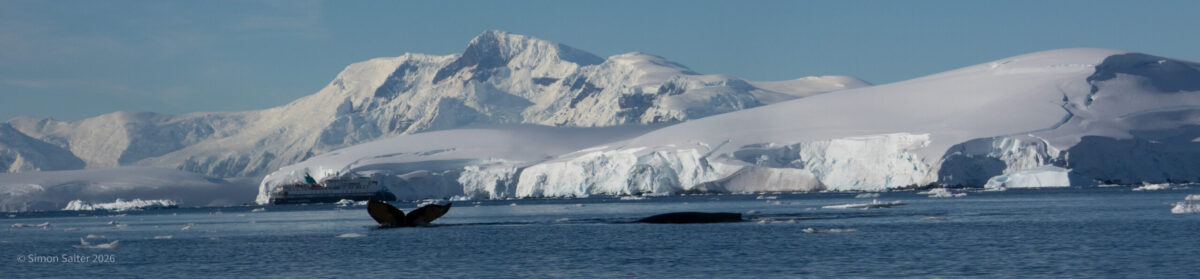
Zodiacs deployed, we all spread out around the bay. A nice feature of the Douglas Mawson is that it carries enough zodiac RHIBs that everyone can get out at the same time. No waiting for a previous group to come back in. We saw a leopard seal, calm and peaceful on an ice floe. A fur seal swam over to look at us. Then a whale popped up. And another. More whales. Whales right across the bay. As one especially enthusiastic cetacean spotter in the expedition team squealed loudly “Whale soup!”.

Several pods of humpback whales were bubble netting. The ocean just there must have been quite rich in krill. Bubble netting is a highly coordinated, cooperative feeding behaviour used to catch large amounts of krill. A group of whales works together to blow a complex, circular “net” of bubbles to trap prey, forcing them into a tight ball before swimming up through the centre to feed. Whales communicate to coordinate diving and feeding. One or more whales may act as the “driver,” while others act as the “blaster” (producing bubbles) and others as “blockers”. We could only see what was happening on the surface which was still fascinating. First thing would be a circle of bubbles forming in the water. This became more intense and then one or two humpbacks would appear, rising headfirst up through the circle. This was the first time I had ever seen the head of a humpback. More usually, you only see their backs and tails.  The whole group would then bob around for a while making great blows of water vapour into the air. Finally, they would dive and, a few minutes later, another circle of bubbles would appear.

Amazing to watch although, obviously, we had to try and keep our distance. Several pods were working the bay. Flocks of birds were following each pod marking them for us. This was all we did for a couple of hours. Drift around the bay following whales. I quite unashamedly present here the greatest number of whales that I have ever photographed at one time. Extreme luck really. Right place, right time. Truly wonderful to watch and also to think that, at long last, the whales are starting to come back from decades of brutal butchery.

Reluctantly, we eventually had to head back to the ship. Then, just like that, our trip was over. Not quite, first we had to steam north through the notorious Drake Passage back to Ushuaia. As darkness fell, we were already leaving the icebergs behind. At 60° S the wind and waves can go right around the planet without encountering land. Low pressure systems whip round here, building in intensity, giving rise to ferocious waves and winds. The reputation of Drakes Passage, the gap between Cape Horn and the Antarctic Peninsula, is well earned but stems mostly from an earlier age. An age where weather forecasting was close to guessing, when vessels travelled slowly and at the mercy of the winds. Today, plans and forecasts are much more reliable. I think I have crossed these waters eleven times now and only once, back then, did we encounter really bad weather.

We spent the day packing and feeling a bit deflated. It had been a truly remarkable trip. We had seen many amazing things. Sights, sounds and sensations unique to Antarctica. For just over a month, we had been thoroughly immersed in all things Antarctic. Up until just a few years ago, I had never really entertained the idea of returning south as a tourist. Our first trip to the peninsula, over a year ago, had mostly just annoyed me. In four days, we saw a tiny bit of the peninsula at arm’s length while being herded around like senile, geriatric sheep. This time, we got a real taste of it and my itch was properly scratched. There was still a small tendency for some of the guides to be a bit superior, contemptuous and slightly patronising. For the most part though, they were friendly and informative. They treated us as equals and shared a genuine enthusiasm for Antarctica. I think a lot of this comes from the leader, Howard, who seemed like a very sincere, sociable and enormously experienced guide.

A late-night mulling over the trip was followed by an early morning disembarkation in Ushuaia. A slightly brutal and dislocating completion of the voyage but the start of something new.

Culverville Island

This is Antarctic penguin central. Biggest Gentoo penguin waddle on the peninsula. At least 6,500 breeding pairs. That is a lot of penguins. Why are they counted in breeding pairs? First answer is that you need a number that is useful in comparing the size of different rookeries. A breeding pair represents potential new offspring. By counting pairs, researchers can calculate “productivity” (the number of chicks hatched or fledged per pair) to understand if a colony is thriving or in decline. Individuals include non-mating birds, young birds and the many wonderful old birds. Even if you could count these then what would the counts mean? Second answer is that it is easier. Pick the right time of year and all the breeding pairs have a nest. You can simply walk through the rookery counting nests. Might look like a small depression in the ground with a couple of rocks in it but to a penguin, it is a nest. Unlike penguins, nests stay still. They are intrinsically easier to count.

Most of the breeding pairs had long since finished breeding and gone fishing by the time we arrived. This still left quite a few penguins and a lot of smelly guano. We had a brief run ashore by zodiac. Gentoos are often quite curious. We are supposed to stay at least 5 m away from any birds. However, if you stand still and the bird comes to you, then the best you might be able to manage is to retreat a little while ensuring that you do not stand on the birds behind you. Many of the birds we saw were youngsters just losing the last of their fluffy chick feathers. Standing around waiting to take to the water for the first time. Penguins have no natural terrestrial predators in Antarctica, making them relatively fearless of humans. Large birds, such as the skuas and giant petrels, will occasionally take eggs and small chicks. They also scavenge carrion.

In the water, danger comes from killer whales and leopard seals. We clambered back into the zodiac and just as we pushed off from the shore a leopard seal came over to us. The previous day, we had encountered a seal that was curious about the boat. This one had brought us a penguin. The birds are fast in the water, like little torpedoes. Leopard seals are faster and young gentoo penguins on their first trip to the ocean make easy prey. This seal was playing with its prey. Like a cat with a mouse. It would let the hapless bird swim a short distance and then catch it again and bring it back to the boat. Almost felt as if the seal was showing off to us.

Obviously, we watched. A mixture of horror and fascination. Each time the poor penguin was dragged back it was getting weaker and more feeble with its fruitless struggling. I would have liked to rescue the battered bird but, not only was this quite impossible it would also not have been appropriate. We were observing a part of natural life in Antarctica. Something that happens right around the continent every day. Eventually the young penguin was dead. The seal was not done with it yet. They prefer to remove the skin with all the feathers before they eat. To do this, the leopard holds the penguin, by its head, and thrashes it back and forth. Takes a while and is very violent. Every few seconds the leopard seal would pop up in a great shower of spray as it whipped the bird through the air. Eventually the skin peeled back revealing a blood red carcass. The skin, feathers and feet drifted away on the surface of the sea chased by scavenger birds. We got a brief glimpse of the satisfied seal and then it too disappeared.

I think everyone in the zodiac was a bit stunned at what we had just witnessed. There was silence. Our driver, Kevin, thought we could try to circumnavigate Cuverville Island while we recovered our sensibilities. More penguins, more seals and some remarkable scenery. Once again we were incredibly lucky with the weather. Most of the time it is cold, windy, overcast and generally unpleasant here. Today it was sunny and lovely.

 We came across another leopard seal relaxing on a chunk of sea ice. He looked at us without concern and actually appeared to be quite cute. Then he yawned and showed us his substantial set of sharp teeth. Not so cute after all.

As we came around the island and were heading back to the ship, we saw a small wooden boat on an island. Strictly, it was just the remains of a small boat. A fur seal watched us carefully and then appeared to indicate to us which direction to go. The boat was something to do with whalers and had been deliberately chained up. Later I discovered that it likely dates back to around 1921.

With that we were done. A steady drive back to the ship after a very exciting morning.

Argentine Islands

We spent the night well away from the coast. The inner channel was clogged with icebergs. The ship stayed clear of this which meant a bouncy night in the open ocean. By morning, things has settled down as we headed back towards mainland Antarctica and the Argentine Islands. The ship eased along some ice choked channels until we were close enough to put the zodiacs in for a landing.

As we work our way north along the Antarctic Peninsula, the place is feeling less and less remote. After many days of not seeing another vessel or any sign of humans, they seem to be everywhere now. Just south of Galindez Island was a cargo ship involved in resupplying the Ukrainian Vernadsky Research Base. We also came across a couple of yachts. They can find a safe mooring here where the inner channels are too shallow to allow dangerous icebergs in.

A leopard seal took quite an interest in the zodiacs. Swimming around them and bobbing up very close. At one point it appeared to be cuddling one of the boats. We later found it had bitten through one of the inflatable tubes that make up the sides of the boat. Fortunately, the hull is made of several tubes and can get along fine if one, or even more, of these is punctured. Eventually, it went off to bother some of the Gentoo penguins and we could get on with looking at some quiet, peaceful, Arctic Terns. Medium sized, pretty birds with an understated toughness. They migrate, annually, from the Arctic to the Antarctic and then back again. Following the sun. A journey of at least 40,000 km a year.

We passed by the Vernadsky Base. They were remarkably busy with cargo operations, possibly their annual re-supply. Certainly, they had no time for us. The base used to be owned by the British. Back then, it was called Faraday Base. After the collapse of the Soviet Union, Russia refused to give any of the old soviet base to Ukraine. However, Ukraine wanted to maintain a presence in Antarctica and, presumably, assert its independence from Russia. In 1992, BAS agreed to sell the old Faraday base for just £1. This gave the Ukrainians what they needed and also got BAS off the hook for the cost of disassembling the base. With good environmental practices and standards this would have been expensive. Since then, the base appears to have worked very well for Ukraine.

A Dobson Spectrophotometer used at Faraday was essential in establishing some of the baseline ozone level data that led to the discovery of the atmospheric ozone hole. The instrument was later moved to Halley Base. In 1985, a paper was published by BAS (Farman, Gardiner, Shanklin) in Nature magazine, based on data from Halley and Faraday, showing the development of the hole. This surprised a lot of people, not least the Americans. Since 1978, NASA had been launching satellites with a Total Ozone Mapping Spectrometer (TOMS) instrument on board. Re-examination of the TOMS data showed that the hole had been missed because the low readings were being filtered out by the analysis software as erroneous data. With the software recalibrated from the Halley ground-truthing readings, the enormity and seriousness of the situation became readily apparent. The importance of this discovery cannot be overstated. Within two years, the Montreal Protocol was introduced. An international agreement that froze the production and use of ozone-depleting substances at 1986 levels and set the groundwork for phasing them out entirely. Today, the protocol stands as one of the most successful international environmental treaties ever implemented. It is proof that we can fix major climate problems if we try.

Some fur seals were eyeing us suspiciously. We ignored them and went to look at some Wilson’s Storm Petrels. There was a group of these tiny birds, along with some Southern Giant Petrels feeding from something in the water. I had been trying to photograph a Wilson’s petrel for a while. They are small and fast and very flighty.  They little perishers will not stay still for anyone. The giant petrels might have a 2 m wingspan and weigh over 5 kg. The Wilson’s however, come in at 40 cm wingspan and 40 g weight (think small fairy cake with gossamer wings). Properly tiny and almost impossible to spot and photograph in the open ocean. Now was my chance, while they were busy feeding. They have a tendency to dance on the water with their feet. This has caused to them being referred to as The Jesus Bird. They make a pilgrimage to land for breeding but spend most of the year, including the Antarctic winter, living and feeding deep in the ocean. Very small and very tough. So, although globally they are quite common, they are not seen all that often.

There is an even older British base a short distance from the working base. This is known as Wordie’s Hut and is a designated ancient site now. We were allowed a brief look around. Some of the kit and equipment was similar to gear I used during my time at Halley. Seems like I too am becoming an ancient monument.

On the way back to the ship we saw several groups of penguins feeding in the water. On land, a bunch of penguins is known as a colony, a rookery or, my favourite, a waddle. In the water they are referred to as a raft. They bob out of the water as they swim along so we get a raft of porpoising penguins. Gentoos are particularly prone to this sort of behaviour.

The Gullet

Next morning we were still in Marguerite Bay. On the east side near the peninsula. Dawn was spectacular. Clear, piercing blue sky. Bright sun. Almost no breeze. It was warm and pleasant out on deck. I spent some happy time taking photographs. In particular, I was impressed at how the mountains were encased in the sort of ice formations that you usually see in much higher peaks. Fluted faces reminiscent of the high-altitude Himalayas. Massive “rime ice” mushrooms, formed by fierce winds and moisture, typical of the great Andean peaks. The mountains here are no slouches. Many are over 2,000 m and would be extreme climbs because of the remoteness and weather conditions. To me, however, they have the character and appearance of much loftier peaks. This gives the area a sense of grandeur and magnificence.

The zodiacs were launched and we all went for a cruise. When I say “all”, I do actually mean most of the clients. There are 84 paying passengers on board and often over 80 go out on the boats at one time. Some of them in kayaks and the rest in the zodiacs. At Stonington, every single customer went ashore, all 84 of us and quite a lot of the crew. This is unusual for an expedition type cruise where there is often a significant contingent that are just along for ride. For us, it was not to be missed.

We bobbed around in the brash and small icebergs. There was a leopard seal that was not at all interest in us. Some bits of unusually clear and dense ice. The cutest baby Weddell seal and a couple more Royal shags.

Back on board, after lunch, we started steaming north and into The Gullet. Your gullet is how food gets to your stomach from your mouth (usually). Also called, the oesophagus. The Gullet is a narrow, 11 nm long, glacier-lined channel in Antarctica separating Adelaide Island from the Antarctic Peninsula. From the north, it is a scenic, ice-choked shortcut to Marguerite Bay, framed by high ice cliffs and towering mountains. It is a renowned, highly scenic, and challenging route. Obviously, our skipper was up for it. Still fresh from setting a world record for southerly navigation, he was on a roll.

We passed by Rothera Research Station. This is the main BAS base for field trips and access to West Antarctica. Unfortunately, we passed so far east of the base that very little was visible. This was a pity. I would have liked to pop in for a brew. Very slightly further north we got mugged by Killer Whales. I don’t mean they attacked us or anything, just that there were hundreds of them. Maybe not literally hundreds but certainly way more than I have ever seen before. Pods of eight or ten individuals kept swimming past us. It was amazing. I took hundreds of photographs and I do mean hundreds this time. For over an hour, we watched groups of Orca swimming south as we were steaming, very slowly, north.

After the Orca had passed behind us, we came back to embracing the incredible scenery. Occasionally, the wind would drop and the sea become calm and mirror like. Diane got extremely excited about this. She loves a good reflection and these were right up there with the best of them. It was a glorious vista. Rugged and peaceful. A brief moment of calm and solitude in a place more usually unwelcoming and forbidding. Our reverie was shattered by the sudden appearance of another ship. The SH Vega. Another cruise ship. The first other vessel that we had seen since leaving McMurdo Sound a fortnight earlier. They had come the easy way. We had come the long way round so we felt we had bragging rights. We did not come close to the Vega and before long she was disappearing behind us. Two ships passing in the early evening.

We continued through The Gullet. Squeezed past a couple of icebergs that were almost blocking the channel and eventually emerged to the north. From here, the inside passage was badly clogged with ice so we moved out to sea and had a rather bouncy night heading for the Argentine Islands.

Stonington

After another day at sea, we arrived at Marguerite Bay off the west coast of Graham Land. The sea day had been quiet and pleasant. Sunshine and a gentle swell. We particularly enjoyed eating dinner while watching albatross and ice bergs float past. I also spent some time on the back deck photographing sooty albatross.

At the north end of Marguerite Bay is Stonington Island. It is only small. 25 m high in the centre. The island is right at the snout of Northeast Glacier and used to be connected to it by a snow slope. The British and Americans had bases here in the 1940s. The British base was used up until 1975. Both bases are now designated as historical monuments. Sir Vivien Fuchs wintered here in 1948 and again the next year when the relief ship failed to arrive. He later went on to lead the first trans-Antarctic expedition and became director of the British Antarctic Survey until 1973. He was a newspaper headline writers dream. For example, in describing a two day sledging trip the headline might read “Sir Vivien Fuchs off for the weekend”.

We had an easy landing by zodiac on Stonington Island. The weather was warm and sunny. The scenery spectacular. Whoever first chose Stonington as a site for a base chose well. To the north is the massive ice wall of the end of Northeast Glacier. This creaks and groans as the ice shifts and occasionally bits fall off into the water. South and west is Marguerite bay filled with icebergs and framed by mountains. Due east is the Bellinghausen Sea. Open ocean clogged with ice. To the west, the mountains rise towards the centre of the Antarctic Peninsula. I have no doubt that, back in the day, many hours were spent in contemplation of this magnificent vista, pipe in one hand and hot cocoa in the other.

Our first stop was to look at some Imperial Shags. The difference between cormorants and shags is elusive. Often there is a difference. A certain type of birder will rattle on for ages describing them. However, there is no consistent scientific distinction between the two although they generally refer to different species within the same family.  English-speaking sailors originally assigned the names somewhat haphazardly. A lot depends on where you are or who you ask. Imperial Shags are also known as Blue-eyed Cormorants.  The cormorants are described as “possessing a distinctive ring of blue skin around its eyes, a orange-yellow nasal knob, pinkish legs and feet, and an erectile black crest”. Sadly, it was not breeding season so no erectile crests to be seen.

We wandered around the beach past the remains of two tracked vehicles and a sleeping seal. We visited the huts. There was not very much going on in either of them. As is often the case with museum type scenarios, I find the stories fascinating but the empty, wooden buildings less so. On the way back to the ship, we came across some moulting Adelie penguins. They typically look a bit sad and fed up while they are waiting for their new coats to grow. They can also appear a little comical. I very much liked punk penguin with the erectile Mohican hair piece.

Back on the ship, things got silly. It was time for the polar plunge. People jumping into he freezing cold water for no good reason. Participants needed to do a medical assessment. The medics were standing by with warm blankets and a defibrillator. Diane and I chose to remain warm and comfortable. We joined the other onlookers leaning over the back of the deck. One by one about 20 people appeared on a platform jutting out from the stern. They jumped in the water, got dragged back aboard and then ran off to resuscitate. Everyone survived and then it was time for a barbecue.

Dining al fresco is always fun as the temperature drops below zero. You wrap up warm and then try to manipulate the cutlery with your gloves on. Food was cold long before it got to the table. The wine, however, was at just the right temperature, so long as you stuck to white wine. We were treated to a spectacular sunset and not long after that brightly shining gibbous waxing moon rose over the mountains to the east. Great place to build a base.

Peter 1st Island

Four consecutive sea days. We needed to move well away from the coast to avoid the great rafts of sea ice that are starting to build up. At this time of year, it is too easy to get caught up in the drifting, freezing ice and, potentially, stuck. We had a ship full of Antarctic enthusiasts but even so, nobody wanted to stay here for the winter. First day out there was not much to see. Pancake ice and fog. The occasional iceberg lurking in the distance. Fortunately, the radar was undeterred by fog. Next day the visibility improved. There was very little fresh ice but way off to starboard we could catch the odd glimpse of the ice edge. We stopped for whales. A large pod of feeding humpbacks. Many people came out on deck to try and grab a photo. The passing days settled into a different rhythm. Whale watching, bird watching, lectures, films, gym sessions. Eventually, we rounded the worst of the pack ice and could head more south. At least a little way.

Peter 1st Island is a very remote and rocky island. Seldom visited. It is remote on many counts. Geographically, it is simply a long way from anywhere else. 450 km off the Antarctic coast – not that there is anything or anyone at that bit of coast. Logistically, very few vessels cross the Amundsen and Bellinghausen seas of Western Antarctica. Nobody comes this way except the odd scientist and a few lonely tourists. For most of most years, the island is usually solidly surrounded by sea ice. Locked in a deep, frigid winter. Gloriously isolated and inaccessible. Societally and historically, there is nothing here. No bases, no old huts, barely anyone has even landed here. There was a small hut once but it has long since been blasted away by the fierce storms that pass as normal weather here.

The island was first sighted by Bellingshausen in January 1821 and named after Peter 1st of Russia. A hundred years later, Larsen was the first to set foot on the island and claim it for Norway. It is small, about 10 km x 20 km, volcanic and almost completely covered by glacier.

We approached from the east. Landings had previously been made on this side. What we found was dark, steep and forbidding. The cloud was low and grey. A stiff, cold breeze made standing on deck quite unpleasantly cold. The swell was substantial. The sky was dark and ominous. We could not see more than a couple of hundred metres up the cliffs. Peering through the gloom, it was just possible to see great seracs of ice and cornices blown snow. Tons of a Damoclean ice perilously overhanging the cliffs. There was no safe place to land here.

The ship backed out and then sailed, north-abouts, to the western shore. As we rounded the northern limit, the sun came out. Above the island, the clouds were lifting. Thick, rounded lenticular clouds were forming high above us. We were greeted by the sight of more steep cliffs, now iridescent in the bright sunshine. The ship steered towards an immense slice of cake. Layers of red and black volcanic ash iced with layers of thick, brilliant white snow, névé and ice. Then the wind stuck. A fierce katabatic blowing straight off the mountains. Katabatic winds are strong, cold, gravity-driven winds that rush downslope from high-elevation ice sheets to the coast. Caused by radiative cooling, these dense, heavy air masses often reach hurricane-force speeds. The ship again backed off as the winds gusted to over 50 knots.

On the island, the cloud continued to lift. The sky was clearing elsewhere and the bright sun was actually beginning to feel warm. We moved back in, a little further north and just past a small, gravel spit, found a place to anchor. The winds had dissipated, we were shielded from the ocean swell and, at last, we could attempt a landing.

We did not land. The zodiacs were launched and we had a pleasant cruise. Close to the shore it became apparent that a general landing would be risky. There was still a significant swell and the shoreline offered very few safe places. Two of the expedition team, fully equipped with dry suits, leapt ashore and scrambled around for a few minutes. A rare landing had been made and we were part of it. Our driver took the boat in close to some cliffs. Diane reached out and touched one of the most remote places in the world. A few moments later, a small avalanche came down the wall close to where we had been. Mostly just powder snow, it would probably have been more unpleasant than dangerous. Even so, best avoided.

Back on the ship, we got warmed up. This was helped by hot chocolate drink served with Baileys. Then I was back on deck for a while, photographing the amazing icebergs as we set sail for the Antarctic Peninsula.

Bay of Whales

Leaving Cape Crozier, we set off along the edge of the Ross Ice Shelf. At 800 km wide, it is the largest ice shelf in Antarctica. About the same size as France. The ice edge is a vertical cliff up to 50 m high. Most of the ice shelf is floating. 90% of it is below water. Hundreds of metres thick. Sailing below the ice cliffs is quite remarkable. A single, solid, bright white line stretching from horizon to horizon. Almost featureless until you zoom right in with the binoculars. Even then it is mostly just flat white ice. Sharp and hard and unforgiving. For over two days, all we could see was this great barrier of ice.

At the eastern end of the ice shelf is an area called the Bay of Whales. This has enormous historical significance. Amundsen started his trip here when he beat Scott to the South Pole. Roald Amundsen set up his base, called Framheim, on the ice shelf and stayed here for the winter. Later, Admiral Bird, built a base called Little America in roughly the same location. There were several generations of this base. All the bases suffered the same fate. First, they got buried by snow and disappeared into the ice. Later, the ice will have broken off and the base would have disappeared down to bottom of the ocean. Sadly, despite the many iconic stories, there is nothing left to see here. Just snow, ice and seawater.

We could not even see the sea. It was freezing over. A thick layer of pancake ice and a lot of fog. Sea fog or ice fog. Caused by the sea being much warmer than the air. Outside, it had dropped to -20°C. The decks were covered by ice. So were the railings, the lifeboats and even the air intakes. A thick layer of rime ice on everything. The blocked vents caused something in the heating boilers to break. The crew were very sketchy when it came to giving us details but my guess is that some heating element burned out because of poor air supply. This is a newly built ship and quite possibly has never been somewhere this cold before. It is designed to operate in the Antarctic but that is not the same as actually testing a whole big vessel in freezing weather. We are in a Chinese built ship, registered at Nassau in the Bahamas, with a captain from Panama. What could possibly go wrong in the Antarctic?

While this drama was going on in the engine room, up on the bridge they were getting quite excited. The southern side of the Bay of Whales is a mass of shifting shelf ice which is constantly breaking off into icebergs. The shape of the navigable part of the coastline was always changing. Exactly now, it was possible to reach a point that was further south than anyone had ever sailed before. In any type of boat or ship. Obviously, the skipper found this irresistible and went for it. 78º 44.405’ S A new world record. It was reported within hours by Wanderlust magazine.

The excitement was short lived. We did not want to hang around. It would be very easy for the ship to get stuck in ice around here and our heating had just packed up. A day later, the sea surface was still covered in pancake ice but it was much thinner. We had moved well away from the sea ice that was spreading out from the coast. The outside air was still below freezing but this was 15°C warmer than in the Bay of Whales.  A little life had been coaxed out of the heating system. Some parts of the ship were cold. A few passengers were moved to different cabins. Our cabin remained lovely and warm.

Cape Crozier

The western end of the Ross Ice Shelf is pinned in place by Ross Island. Cape Rozier is last bit of land before the long, long ice cliffs. 800 km of steep, high, white ice. We got there in the morning and went out in the zodiacs.

It felt chilly. A few degrees below zero augmented by a stiff breeze. We set off along the shore where there are large colonies of Adélie and Emperor penguins. As it was elsewhere, nobody was home. There were a few stragglers standing around but mostly just empty, dark volcanic beaches covered with a thick layer of lighter coloured guano.

The cape was discovered in 1841 by James Clark Ross’s polar expedition. It was named after Commander Francis Crozier, captain of HMS Terror. Four years later, Crozier with Terror and HMS Erebus, Ross’s other Antarctic ship, attempted the Northwest Passage at the other end of the planet. We encountered these sturdy, historic ships, or at least the site of their wrecks, about 18 months ago.

At the end of the beach was an interesting little cove made by the shelf ice. I was fascinated by some icicles with balls. Thin, icy columns cause by melt water had grown down from the ice until they touched water. Then the freezing sea water accumulated on the end like a little frosty bauble. This made some gloriously intricate and delicate patterns along the bottom edge of the ice cliffs.

Just around the corner was yet another phenomenon I had never seen before. Great plumes of spray jetting out of the top of the ice cliffs. You see this sort of thing occasionally in stone sea cliffs. A cave close to sea level has an outlet to the surface. When a wave washes into the cave, water gets pushed up and sprays out above the cliff. I think something similar was happening here albeit in a much more dynamic way. Sea water was forcing open a crack in the ice. The crack would originally have been a crevasse. Some combination of melting and re-freezing was causing spectacular blow holes to appear in one section of cliff. There was something like half a dozen of them in just a short section. A first glance they looked like whales blowing but obviously there were no whales on top of the cliffs.

Ice was accumulating on the rubber boat and on my hands. In the second hour of sitting in the boat ,without really moving at all, bits of me were starting to go numb. I think everyone got a touch hypothermic by the end of the trip. It was, however, spectacular and well worth getting out of bed for.

Cape Evans

Another day, another hut. This time it was Scott’s hut on Cape Evans. Considerably larger than Shackleton’s hut at 15 m by 7.5 m. Prefabricated, well-made and well insulated with dried seaweed. Lighting was by acetylene gas. A small gas generator is by the door. I cannot find a description of how this worked. I think it will have used calcium carbide. Dripping water onto carbide makes acetylene gas. I used to have a caving lamp that worked like this. It has quite a distinctive smell but makes a good light and will have helped warm the hut as well. If carbide was used, then it will probably have been all removed by now. It is quite reactive and a build up of acetylene can be explosive.

A stable was added to the side of the hut and a utility room. Heating came from the kitchen range plus an additional stove in the officers’ quarters. While Shackleton was completely egalitarian over the layout of his hut, Scott maintained a clear class division. The hut is separated into two parts with a room divider made of packing cases. Officers and men even had separate dining tables. The hut has been beautifully restored. It looks just as it might when it was in use. Maybe not exactly the same but similar or reminiscent, anyhow. In the stable are a pile of penguins and a palette of seal blubber. The dark room has chemicals on the shelves. A harness for pulling sledges is hanging off a bunk. The kitchen looks well stocked. There is a penguin on a side table all ready for dissection and a newspaper dated 1908.

The hut was built in 1911. That winter 25 men over-wintered in it. In the early summer, 16 men set off for the South Pole. In the final push, Scott and four others made the pole but never made it back to the hut. One of many tragic and heroic stories from Antarctica. Several other trips were made from the hut. A winter trip to Cape Crozier almost ended in disaster. A northern party sailed to Cape Adare and ended up spending two winters. The second, in a snow cave where they suffered appalling conditions and extreme weather. A geological expedition went essentially to plan. However, the second trip got into trouble and were eventually rescued by ship off the sea ice.

We were told to keep our voices low when we around the hut as a sign of respect. This reminded me of when we visited the Sistine chapel in the Vatican. A guard there told me to remove my hat as a sign of respect. I was dying to ask how he knew God had a problem with hats. The guard seemed a bit stern and devoid of a sense of humour, so I kept quiet. Entry and exit to the hut was carefully controlled. We had to clean our boots. Only four at a time inside. No rucksacks. No touching. As we were leaving the hut, I really wanted to say, “I am just going outside and may be some time” but on balance it seemed better to keep quiet. Too many people looking profoundly serious.

The hut was reused in 1915 when Shackleton’s Ross Sea party got into trouble. Fortunately, the well-stocked hut provided a relatively comfortable refuge until Jan 1917 when Shackleton arrived to rescue them. The hut was untouched until 1956 when it was dug out by an American team and found to be in a remarkably good state of preservation. Since then, it has been maintained to give visitors a little insight into what life would have been like.

At Hut Point is Scott’s first hut. This was our destination for the afternoon. Hut Point is also the location of the McMurdo base run by the USA. This is, by an order of magnitude, the largest base in Antarctica. We were told that the wintering team, all 200 of them, were just settling in and could not accommodate visitors. By way of comparison, my wintering team at Halley was just 18 people. Our expedition team also found out that it was impossible to get to Discovery Hut because the remains of the sea ice formed a barrier. We sailed past McMurdo base slowly to get a good look at it. Just around the corner is Scott base. This is the New Zealand base. A modern looking base painted the same green as the hut at Cape Bird. New Zealand green. Obviously, a tiny base compared to McMurdo.

Further on we came to one of several runways. This appeared to be a thoroughly busy place. We watched an aircraft take off. As evening fell, the ship bobbed around in the pancake ice by the edge of Ross Ice Shelf. A group photograph was done here. After this we went to bed and the ship set off to sail around to Cape Crozier.

Ross Island

Ross Island is interesting. It is not very big, just 80 km across. McMurdo base is there. The most populous base in Antarctica. Up to 1,200 people. Run by the USA. Nearby, Scott base is run by the Kiwis. They also have a hut to the north of the island. There are three historic locations, restored wooden huts from the Heroic Age of Antarctic Exploration. The island also has two volcanoes. One is considered extinct while the other smoulders away, venting smoke almost continuously. The land is all snow covered with five large glaciers radiating from the centre. One side of the island is effectively connected to mainland Antarctica by a permanent ice sheet. The ocean on the other side freezes every winter but is navigable for part of the year. The world’s most southerly port, at Hut Point, is typically opened by ice breakers in the spring. From here a seasonal marked route runs 1,600 km to the South Pole. Greenpeace once had a base on Ross Island. It really is an interesting place.

Our first stop was at Cape Bird. Given all the potentially interesting locations on Ross Island, this is possibly quite low on the list. There is a small hut for scientific observations. Owned by NZ, there is no-one there at the moment. To one side, between the hut and glacier, is one of the world’s largest Adélie penguin rookeries. Except, just now, as elsewhere, the birds have all gone. Only a handful of Skuas with some late chicks, a few moulting penguins and a massive smell. The sun was out. There was not much breeze. The prurient penguin pong was prodigious and pungent.

We walked along the beach as far as we could go. Then back again, a slightly different way. There were a few seals snoozing by the waters edge. There were a lot of penguin feet. Many chicks die before reaching adulthood. Our guide assured us that only 10% survive the first year. The reality is between a third and two thirds but even so that is a lot of dead penguins. Skuas clean up the dead chicks. They are also responsible for some of the dead chicks being dead. However, Skuas appear to not like the feet. Little desiccated penguin feet are scattered all over the beach.

In the afternoon, we went to visit Shackleton’s hut. This was much more interesting and did not involve a beach of penguin bones and guano. First, we had to sail across the bay to Cape Royds. This gave us a chance for lunch and to watch some orca. We saw several pods of Ross Sea Killer Whale. They are a distinct species, endemic to the Ross Sea. None of the whales came particularly close to the ship. In fact, they all appeared to keep roughly the same distance. Near enough to be seen, far enough to deny a good photograph.

Shackleton’s hut is a designated historical monument controlled by The Antarctic Heritage Trust (New Zealand). The hut was prefabricated in Britain and taken south for the first expedition led by Shackleton. The intended location proved inaccessible, so it was erected at Cape Royds. Establishing the base was difficult. Unloading the ship, the Nimrod, took nearly three weeks. They were hampered by harsh weather, ice conditions and disagreements with the ship’s captain. 10m by 6m, the hut was home for 15 men during the winter of 1908. From here, the expedition achieved the furthest ever south (88°23′ S), the first ascent of Mount Erebus and the discovery of the location of the South Magnetic Pole

The hut was left in good condition with enough supplies for 15 men for a winter. A letter, inviting any subsequent party to use the hut, was left inside. The door was locked and the key prominently nailed to the door. More recently, the Heritage Trust have repaired and reinstated the hut so that it still looks as if Shackleton only just left. The dog kennels are outside. Food and other supplies are inside. Fortunately, the cold, dry conditions of Antarctica help preserve the hut as a museum. Access is carefully controlled and restricted. We needed to clean our boots and only four people were allowed inside at a time. In 2010, several intact cases of whiskey were discovered underneath the hut. The original distillery has now recreated the taste of Shackleton’s whiskey. You can buy a bottle, for a premium, but that does include a donation to the Heritage Trust.

We wandered around the area. There is a small hill with some nice views. A frozen lake with a few penguins sliding across it. Diane did her penguin impression. I wondered about how Shackleton’s hut got its water supply. Usually, at a small Antarctic base, the water comes from melting snow. You need a good supply of clean snow. It is cut into blocks and melted in a large pot on the stove. When we visited the hut, it was surrounded by penguins. Extremely cute but far from ideal when it comes to clean snow.

In the evening, we headed across the sound towards Cape Bernacchi. The sun only sets for about three hours at night. Late in the evening, it was low but still bright. We had some wonderful views of the mountains and could watch ice starting to form on the water. When the sea first begins to freeze over it forms little circular patches called pancake ice.

Cape Hallet

100 km or so south from Cape Adare is Cape Hallett. It is a very picturesque area dominated by the Admiralty Mountain Range. The mountains were discovered in January 1841 by Captain James Clark Ross, Royal Navy, who named them for the Lords Commissioners of the British Admiralty under whose orders he served. Back then, naming geographic features after your sponsors was a well-established and successful ploy for obtaining further sponsorship.

A large Adélie penguin colony is located on the southern side of Cape Hallett. This is where we went zodiac cruising. Conditions were perfect. Calm water, sunshine, a few icebergs with seals lazing around on them and the distinctive smell of the penguin rookery. As with the other places we have visited, most of the penguins have left now and gone to sea. Just a handful of moulting penguins and a lot of guano to show for it.

We pottered around for the best part of two hours. Looked at some penguins. Looked at some seals. Saw a leopard seal but could not get a good picture of it. Mostly because it was sound asleep and not at all interested in us. We looked at some rocks and listened to someone who knew a bit of geology. That was quite interesting. Volcanic features. We looked at some glaciers. One of the guides started talking nonsense. They do this occasionally. They assume that we, the clients, know absolutely nothing about where we are. So, sometimes, to fill the silence, they start telling us stuff as if they know what they are talking about. It is best just to let them get on with it. They never suspect that, sometimes, old people know things.

Back on the ship there was talk of a weather window. We were heading right down to the bottom of the Ross Sea. This is, traditionally, the most reliable way to get south. Shackleton, Scott and many other heroes came this way to Ross Island. Scott named it after Ross. He did not have to. Ross was dead by then and Scott’s funding came from Royal Geographical Society and the Royal Society. Ross, however, was a pillar of Antarctic exploration and this sort of thing went well with the London based leather armchair explorer societies. Our issue was that Antarctic weather is changeable and occasionally ferocious. To take advantage of the weather window we needed to get on with getting to Ross Island.

The zodiacs were packed back onto the ship and we set a course south. For the whole of the next day, we made good speed. No sea ice, very few icebergs, beautiful sunshine and just a few birds following the ship. The expedition team drummed up a few talks. I got on with this blog. Diane got in some essential sleeping time. At Ross Island things were going to get very busy.

Cape Adare

We are woken every morning by an announcement on the ship PA system. Fortunately, Howard, the expedition leader, has quite a gentle voice. His wake-up call with the weather and daily program is more Radio 4 than Heidi Hi. This is a good thing because otherwise I would need to work out how to disconnect the speaker in the cabin. It can be a bit of a guess as to what time we are going to be woken. This particular morning it was before dawn.

Sunrise proved to be quite spectacular making the early start worthwhile. Tabular icebergs (the big flat ones) were floating past. Seabirds were flying around the ship. A pod of killer whales went past. It was all turning out to be an extremely exciting morning.

After breakfast and a second pod of Orca we arrived at Cape Adare. Historically this place is extraordinarily significant. It is the site of the first ever landing on mainland Antarctica. It is also the first place anyone ever spent a winter on Antarctica. Biologically it is the location of the largest Adélie penguin rookery in the world. The first big impression Cape Adare made with me was the stink. The beach has an entire geological layer of penguin guano. Relatively few birds are here at this time of year but over 200,000 breeding pairs not so long ago. Today the sun is out and the beach area is warm, soft and vibrantly pungent underfoot.

We went ashore in zodiacs to have a look at the huts. Through the Antarctic Heritage Trust the site is registered as an Antarctic Specially Protected Area (ASPA 159) the highest level of protection available under the terms of the Antarctic Treaty. We need to tread carefully and speak in hushed tones. In January 1895, Norwegian explorers Henrik Bull and Carsten Borchgrevink landed here. Borchgrevink claimed to be the first to step onto the Antarctic mainland. Or it might have been Leonard Kristensen, ship captain, as cited in expedition accounts. Or Alexander von Tunzelmann, a 17 yo deck hand who claimed he jumped out to steady the boat for the others. Borchgrevink came back in 1899 as leader of the Southern Cross Expedition, also known as the British Antarctic Expedition. They erected two huts in which to spend the winter. The very first winterers and the very first buildings in Antarctica. This was the first British venture of the Heroic Age of Antarctic Exploration. Later, Scott and Shackleton would become famous for their exploits. But nobody particularly like Borchgrevink. He was Norwegian and we would have preferred a reliable British Naval Officer. He also had an abrasive personality that appeared to upset pretty much everyone he ever dealt with. These two traits led him to becoming the first Antarctic hero that you never heard of. He received some recognition thirty years later. The Royal Geographical Society admitted “justice had not been done” to his work and awarded him the Patron’s Medal.

Members of the Northern Party of Scott’s Terra Nova Expedition over-wintered at Cape Adare in 1911 and 1912. They erected one hut, which has fallen into ruin today. The Norwegian built huts have fared much better. Zoologist George Murray Levick made observations of the penguins throughout the year and was horrified. He saw “depraved behaviour” including “hooligan penguins” that exhibited homosexuality, necrophilia (mating with dead females), sexual coercion and the physical abuse of chicks. Returning to Britain, his paper Sexual Habits of the Adélie Penguin was deemed too graphic for the official expedition report. His lost paper was rediscovered at the Natural History Museum and published in full in 2012. What Levick regarded as “moral failings,” modern biologists consider the result of sexual inexperience in young birds and high hormonal levels during the short, intense breeding season. Life can be hard as a teenage penguin when nobody understands you.

Diane had a quick look inside the huts. Despite their enormous historical significance, they actually look like a pair of old garden sheds. We wandered around in the penguin poo for a while. Back in the day, superior quality guano was a rich source of nitrogen for fertiliser and gunpowder. Borchgrevink the unloved, had even submitted a commercial proposal to collect the droppings.

After the breeding season comes the moulting season. A catastrophic moult is critical for survival. It replaces every single feather to ensure they remain waterproof and insulated. Typically lasts between 2 and 4 weeks. Without their waterproofing, penguins cannot enter the water to hunt. To survive, they must gorge on food before the imposed fast. This can double their body weight which makes them extra tasty to predatory killer whales and leopard seals. At this time of year, most of the birds have headed off to sea. The remaining slow moulters stand around looking shaggy and a bit despondent.

We were saved from nasal assault by the offer of a zodiac cruise. This gave us the opportunity to look at some odd shaped bits of floating ice. As icebergs melt and occasionally roll over, they can assume some strange patterns. Glacial ice typically forms in annual layers. This striation combines with patterns caused by wave action, meltwater and gas bubbles to form a remarkable range of shapes and textures. We also saw a few minke whales, a few Weddell seals and the first Emperor penguin of the trip.

Bellany Islands

Sailing south from Macquarie Island we had a couple of sea days. Nothing much happening. Nothing much to see. I spent some time on the back experimenting with camera settings. My relatively new Canon EOS R5 MkII is a lovely camera but has way too many options. It also has way too many complex and fiddly controls to manage all the complex and fiddly options. A lot of learning is needed to master the beast. I try and take this in small and manageable slices.

Antarctica is in a state of political limbo. Slices of it are claimed by various countries. Many of these claims are overlapping. Antarctica has no permanent population, no citizenship and no government. There is no Antarctic sovereignty. Personnel present in Antarctica are always nationals of some other country. In 1959 the Antarctic Treaty was ratified by most of the countries with a stake in Antarctica. Think cold war. This was primarily an arms control agreement. It designated the continent as a scientific preserve, established freedom of scientific research and banned military activity. To date this has worked well. There have been a few minor skirmishes but the treaty serves everybody’s interests, so far, so it prevails. I worked in Antarctica 35 years ago and was always extremely impressed by international spirit of scientific cooperation it engendered. Unfortunately, in my opinion, the robustness of the treaty is like a house of cards. To date, Antarctica has only been useful for scientific research. That is changing. When I worked down south, there were no tourists. None. A half dozen brave people in yachts would visit the very northern tip of the peninsula. Last year there were 120,000 tourists. Numbering a mere 5,000, the scientific community is in the minority these days. What is more, these tourists not rough and tough hardy types. Far from it. They are mostly of the retired demographic enjoying a comfortable lifestyle. We are spotting icebergs from the bar of the observation deck while sipping a gin and tonic and nibbling a few salted cashew nuts.  

The winter is still harsh. Less than 1,000 people on the whole continent and no tourists. No doubt this will change. However, I am not suggesting that tourism will be the problem. To date, the increase in visitors appears to be benign. Antarctica is uniquely vulnerable but even so, it is a whole enormous continent. 120,000 people spread quite thinly. The International Association of Antarctica Tour Operators (IAATO) is the tourism body for self-regulation. They report to the Antarctic Treaty Consultative Meeting, an annual forum for Antarctic Treaty nations to exchange information, discuss matters of common interest, and formulate measures for managing the Antarctic region. This is voluntary self-regulation. IAATO is all set up to look very official. The implication and likely ambition, is that for a tour operator to work down south they will need to be a member. Like most standards, it primarily benefits the organisations that set the standards while putting barriers in the way of aspirants. I would anticipate that getting the necessary governmental permissions to visit Antarctica is greatly facilitated by membership.

Antarctica will get into trouble at some point on the current global socio-political trajectory when technology and resource scarcity intersect. The inauguration of President Trump initiated post-truth politics. Since then, we have seen a collapse of the social growth of civilisation in favour of capitalist greed and isolationism. Events such as Brexit, the reappearance of war in Europe and Trump’s second term are points on a line that reinstates a world order based on power and nationalism. As, and when, necessary resources in Antarctica become economically viable to access, one of the superpowers will be there. No amount of waving the Antarctic Treaty documents will make any difference. While staring out of the cabin window with the gloomy thought in my head, I saw the first iceberg go past. This was much more interesting. Not far ahead was the first sea ice. A strip of loose, brash ice that had probably been floating around for a while.

Next day, we were bearing down on the Bellany Islands. A remote, uninhabited volcanic archipelago, approximately 325 km north of the Antarctic coast. Discovered in 1839, the chain, is heavily glaciated, features steep cliffs, and is rarely visited due to harsh weather and ice. We aimed for the middle of the three islands. This meant we has to cross the Antarctic circle to get there. The event was taken as an excuse for celebration. King Neptune visited the top deck. There was cheering, photographs and a toast. I avoided the nonsense and got on with trying to master the camera.

Meanwhile, as we closed in on the shelter of the islands, the wildlife began to appear. Seabirds, a few penguins standing around on ice floes and whales. A lot of whales. Mostly sperm whales, I think. Every few minutes there seemed to be another puff of water vapour from a whale blowing.

The zodiacs were put in the water and we had a short cruise between Sabrina and Buckle Islands. The wind had picked up again making the sea quite choppy. It was mere minutes before we were all soaked by salty spray. But it was worth it. There was a small group of whales feeding and we could get close to them. An intense flock of cape petrels marked the spot and every couple of minutes one or more whales would pop out of the water. Difficult to take photographs with the cold wind and the spray but an amazing privilege to watch. Back on the ship, we had a hot shower and then settled down with a glass of wine to be served an excellent meal. Such is the way of the modern Antarctic explorer.

Macquarie Island

Very remote and very interesting. Macquarie Island is a recent island. Formed less than 700,000 years ago. That is ludicrously young in geological terms. It is also very unusual because it is made of uplifted and exposed oceanic crust. Formed by the collision of two tectonic plates, the island was squeezed up from deep below the ocean like toothpaste from a tube. Geologists get extremely excited about this place. They can see rock structures here that are almost inaccessible anywhere else in the world. To me, it looked like some quite ordinary hills covered in grass. There is little that is obviously unusual to the untrained eye. I tried to spot some pillow lava but failed. This is rock formed by the rapid cooling of lava underwater. Spotting anything was quite difficult as we were carefully herded around and not even allowed to pick up a rock.

Macquarie Island is also the scene of the most incredible animal slaughters. Beginning with the sealers who “discovered” the island in 1810. They killed 120,000 fur seals in just the first 18 months. By 1820, at least a quarter of a million fur seals been taken rendering them virtually extinct. Attention then turned to elephant seals which were similarly slaughtered. By 1830 70% of the elephant seals were gone. Then it was the penguins turn. They were herded along planks and pushed into steam powered digestors. 2,000 penguins at a time producing half a litre of oil per penguin. In 1933, when nearly everything had already been killed and there was no longer a market for seal or penguin oil, the island was declared a wildlife sanctuary. Since then, seal numbers have mostly recovered and the penguins have come back.

However, this was far from the end of the slaughtering. Mice and rats had come ashore with the sealers. These were causing mass destruction with the sea birds. Cats, introduced to protect human food from the mice, were also helping themselves to the bird life. An estimated 60,000 birds per year. Rabbits, released to provide food in 1870, were running rife and destroying the local vegetation. The rabbits were reduced to about 10,000 in the early 1980s when myxomatosis was deliberately spread around. Over time they developed a resistance to the desease and by 2006 there were over 100,000 bunnies. Rats and mice feeding on young chicks, and rabbits nibbling on the grass layer, has led to soil erosion and cliff collapses, destroying seabird nests. Substantial portions of the Macquarie Island bluffs are eroding as a result. In September 2006 a large landslip at Lusitania Bay partially destroyed an important penguin breeding colony. This was attributed to a combination of heavy spring rains and severe erosion caused by rabbits.

In 2007 a program to eliminate the rats, mice and cats by poisoning was started. This cost over £12 m and involved helicopters spreading poisoned bait all over the island. It was mostly successful but unfortunately also killed large numbers of kelp gulls, giant petrels, black ducks and skuas. The program was abandoned early but followed up by hunters with dogs. By 2014 the result of the biological, chemical and ballistic warfare on the animals was declared a great success. The island was pest free. Populations of many bird species have increased and the plant life is recovering. Avian influenza, bird flu, is likely going to be the next big killer. It has not reached Macquarie Island yet but elsewhere in the sub-Antarctic regions it is becoming responsible for the deaths of large numbers of seabirds, penguins and seals.

We arrived at “Macca” early in the morning. On the isthmus right on the northern end is quite a large research base. Obviously, they wanted very little to do with a bunch of tourists. A couple of rangers came down to the shoreline to discuss the sea state with our crew. It was decided that there was too much swell for a safe landing. Meanwhile, I had been leaning over the side of the ship and was surprised at how many penguins were swimming round us. They were mostly King Penguins. Quite large birds with very striking colouring. It was almost like there was something about the ship that they found attractive.

We pressed on south to an area called Sandy Bay. Here there was less swell. The whole area was a bit more sheltered. There were some elephant seals on the shore along with many king penguins and a few royal penguins. These are smaller, yellow crested penguins endemic to the area. We had a small patch of beach to wander along and also some steps to a viewing platform. Despite the small area, we were carefully organised into groups and assigned to a guide. We spent about an hour mostly just standing around photographing the creatures. Penguins are very smelly. You don’t get this when watching a documentary. Once you are physically close to a rookery there is an extraordinarily strong and quite distinctive stench.

Along with the penguins, there were a few skuas and giant petrels on the beach. Birds, penguins, seals and tourists all squashed up next to each other. Our last stop was the viewing platform for the royal penguin rookery. I had never seen this type of penguin before. They only breed here, on Macquarie Island. A high-risk strategy. Macca is subject to frequent earthquakes. Occasionally these can be strong and may also give rise to tsunamis. Funny looking birds with bright yellow and rather dishevelled crests.

Back on the ship we moved further south to Lusitania Bay. There are many more royal penguins here but no good landing places. On the beach, a couple of the large digestors used for boiling penguins down, can be seen rusting away. We went out in the zodiacs to bounce around for a while. The wind was getting up and so was the sea. I left my main camera on the ship. This proved to be a good decision as within a few minutes we were getting soaked in the little RHIBs. A couple of orcas went past as we were heading back. The wind and spray was making visibility quite poor by then but we still managed to catch a glimpse of two black dorsal fins.

Macca done, the ship set sail due south.

Campbell Island

Campbell Island has the distinction of being the closest land to the antipodal point of the UK. The antipode of any location on the planet is the point on the globes surface diametrically opposite to it. Points that are antipodal to each other are situated such that a straight line connecting the two would pass through Earth’s centre. In other words, we are as far away from home as it is possible to get.

Far from home and in trouble. Our cabin came up on the naughty list today, so we had to go and clean our boots. Yesterday there was a general discussion on biosecurity. The issue, the problem, is cross contamination by non-native species to the sub-Antarctic islands. Back in the day it was common to introduce new species in the hope of improving things. Pigs to help castaways, plants that might grow better, that sort of thing. There was also truly little control over the accidental introduction of foreign organisms. Rats came ashore off ships. Cats were brought to control the rats. Food stuffs contained seeds which got into the local environment and so on. Unfortunately, some of these foreigners became invasive and changed the ecological balance of a whole island. Rodents could wipe out entire bird species. The avians had never dealt with mammalian predators before and were devoid of defences. Similarly, some plant species could end up displacing local, more specialised varieties. Rabbits could munch particular and rare types of vegetation into extinction. These are all valid and real concerns. The basic approach, to ensure that no cross-contamination occurs is valid. However, there is this pendulum thing again and I do wonder if some people go a bit overboard. The end of the talk explained how we could use an opened paper clip to pick the grains of sand out from the label on our boots. We were also told about a spider. This had been spotted in a corridor. It was now safely caught, identified, boxed and packed into a freezer for return to New Zealand.

Biosecurity requires that we cannot go to the toilet when we go ashore.  Because a shore trip can last three or four hours this means getting yourself into a state of dehydration before you leave the ship. Half rations on the coffee at breakfast and no orange juice. Today we went for a walk up a hill. A little over 7 km up a steady slope and then back again. The weather was wet and windy. Gusting 30 knots near the top. This would have been a steady morning stroll with a flask of tea and some biscuits to have at the summit. But no food allowed. At all. Nothing. No tea. You can take some water but if you drink it then your bladder will have to suffer the consequences until you get back to the ship. It was quite a nice walk and I mostly enjoyed it. We passed several nesting albatrosses and there were some interesting views when the clouds briefly lifted. Diane found it very challenging. You are not allowed to sit down. Not even any kneeling. A few breaks, being properly hydrated and some chocolate would have made all the difference. There was a bench at the top where we had a brief respite. The wind picked up some more and the guides appeared to get into a bit of a panic. They started clucking a lot. We all had to group together. We should stop and squat down (without sitting or kneeling) if there was a strong gust. There was quite a lot of shouting, unnecessary organising and general confusion. Fortunately, as we dropped down the hillside, the wind dropped and things calmed down a bit. There was an incident with someone trying to take a selfie with an albatross on a nest and that did, quite rightly, end in a bit of a ticking off.

Getting back to the ship was a big relief in many ways.

Enderby Island

This morning the expedition team announced and posted their first naughty list. The night before, they had been round the lockers in the mud room checking everybody’s muck boots. If they were not clean enough, you were put on the naughty list. Anyone on this wall of shame needed to go down to the mud room and scrub their boots before breakfast. Fortunately, Diane and I escaped the dawn punishment and we could have a peaceful breakfast.

Enderby Island is the most northerly of the Auckland archipelago. The island’s northernmost point is Derry Castle Reef, named after the ship which foundered there in 1887. The sole passenger and 7 of the 23 crew made it ashore at Sandy Bay. They found a castaway depot but it had been looted. After 92 days they discovered an axe head in the sand and were able to build a boat from the wreckage. With this they could reach a second depot at Port Ross. Here they survived for a couple more months before finally getting rescued.

They may have dined, at least some of the time, on rabbit. The animals had been introduced to the island 20 years earlier specifically for this purpose. It was a common practise. Elsewhere, pigs, sheep and even cattle had been left on islands for the benefit of shipwrecked sailor. The Enderby rabbits were there for 130 years by which time they could be classified as a distinct species. The rabbits were eradicated from the island in the early 1990s. A few were rescued and the breed still survives in captivity.

We also went ashore at Sandy Bay. There are a few researchers huts here and also quite a lot of sea lions. The males can be a little territorial and not so welcoming to tourists. We didn’t have any trouble but there was an interesting stand-off with one of the expedition team when another group came ashore. Elsewhere there were groups of female sea lions lying around. Also, young pups playing with each other. Like most pups, these can be quite fun to watch.

We tip-toed round the various groups of sea lions and then could follow a walkway up the hillside a short way. This gave us a nice view and also took us past a few nesting albatrosses. These were Royal Albatrosses. Big birds with a wingspan of over 3 m.

Coming back down, we needed to circumvent another large sea lion male which had set up on the path. “Don’t stop, don’t take photographs and avoid eye contact” we were instructed. Some of the expedition crew get quite domineering and like to order the rest of us around like we were school children. Occasionally this is irritating but mostly I find it faintly amusing. I ended up reflecting on the notion that for well over 200 years it had been perfectly acceptable to club to death anything that looked like a seal. Now, we were being told to not even look at them. Behavioural pendulums swinging between extremes.

Back on the beach we spotted a yellow eyed penguin. These are endangered and quite rare. I took a photograph. It is not a very good photograph but I do at least have a picture of a yellow-eyed penguin.  

Snares Island

First day on a new ship is often all about finding things. We had never been on this vessel before or with this company. We knew nothing about how things were done or where they were done. The night before we had found our cabin, always a good start. Also found the restaurant so today we knew where to go for breakfast. There was a man there making omelettes. Not quite a masala omelette but pretty good and with a few chilli flakes on top I felt off to a good start. Coffee, yoghurt, fruit, toast. Grilled tomatoes and hash browns to go with the omelettes. We were going to survive. At least until lunchtime.

We were issued with muck boots. Big, warm, waterproof neoprene boots for going ashore. These are kept in a locker room on deck 3 which is called the mud room. I am not sure why. Our life jackets to use in the Zodiacs are also kept there. I thought that was going to be about our lot for the day’s excitement. On the itinerary, it was designated a sea day. Instead, mid-afternoon, we arrived at Snares Island. I thought this was a much better idea that bobbing around in the ocean. As we approached, there were many birds circling the ship. In particular, some albatrosses. I spent a while trying to photograph them. They are large but move fast. Also, the ship is moving. If you concentrate on the view finder too much you are liable to lose your balance and fall over.

There are about eighty passengers on the ship. Not very many but even so, if everyone is invited to the mud room at the same time to don boots and lifejackets, it gets a bit chaotic. Aurora could take some notes from the other expedition ships we have been on. We eventually got our boots and life jackets on but then we did not know where to go. First, we were queuing on one side of the ship, then the other, then we were waiting, then it was cancelled and ten minutes later it was back on again. We kept smiling and hoped the crew’s organisational abilities would improve once they had got over the teething problems.

The sea state was marginal. It was not particularly windy but there was a good swell running. Getting in and out of the zodiacs requires careful timing. They rise up and down well over a metre compared to the ship. The trick is to wait until the RHIB is on the top of the swell and then step purposefully across the gap. It is not as difficult as it sounds. For me the bigger problem was all the crew members grabbing at my arms and shouting advice. Somehow, we all manged to get into the boats and set off for a look round.

The smaller zodiacs could get into the lee of some islands and small inlets. So, once we were away from the Douglas Mawson, everything seemed to settle down a bit and we could get on with looking at the flora and fauna. The Snares Islands are a group of uninhabited islands lying about 200 km south of New Zealand. They are significant as a bird breeding area and have several endemic species, notably the Snares Penguin and the Snares Tomtit. The islands are heavily protected and generally it is not allowed to land on them. Having a look round in a small boat is fine.

Our trip began with a cave. This was fun and unexpected. It also brought us to a very calm little cove which was teeming with wildlife. We saw plenty of the yellow crested Snares Penguins. We also saw a tomtit which I failed to photograph. However, I was luckier with a Snares Snipe. There were quite a few fur seals lying around and a bewildering variety of sea birds. We came across a great mass of birds floating together in the sea. I can only assume that there was something plentiful and good to eat here.

We were out in the boat for well over an hour. There was far less chaos about getting back on board and then it was dinner time. In summary, a good start to the voyage.

Leaving Dunedin

Monday morning. We were ready to set sail but the ship was not ready for us. Our ship, the Douglas Mawson, had docked early in the morning and disembarked her passengers. However, there were many things to do, like cleaning the cabins, before we could be allowed on board. The company that owns the ship, Aurora, put in place a program of activities for the day to keep us distracted. This began with telling us to go away and come back to the hotel at lunchtime.

We wandered down to the Chinese Gardens. For a modest fee you can wander around this small, tranquil garden. It backs onto the railway track and is surrounded by city buildings. High walls keep most of this urban pressure out and a lovely pond area draws your attention inward. Were I stuck in Dunedin again, I don’t think I would go out of my way to visit these gardens but we had a couple of hours to kill so it was fine.

Back at the hotel we joined a group for an hour’s walking tour. This was all about the street art. Dunedin has a bit of a reputation for painted walls. There is some graffiti but most of the paintings have been commissioned by the city. Some of the pieces, up to a decade old, are getting a bit tatty around the edges now. Our guide was very enthusiastic about the plethora of murals we were shown. I didn’t share his engagement but it did pass another hour.

Next up was a bus ride. We all piled into a coach and were driven around the outskirts of Dunedin. Eventually we rocked up at the ineffably famous Baldwin Street. This road is officially recognized by Guinness World Records as the world’s steepest residential street. 19°, 35% or 1:2.78 depending on how you like to measure these things. It is 350 m long and, apart from being steep, is very ordinary. I declined the invitation to walk to one end of it. Instead, we stayed on the coach. As did many other people. We reflected that we had paid a lot of money for the Antarctic trip of a lifetime and were being shown a steep road.

Then came the Dunedin Botanic Garden. This at least gave us the chance to use a toilet. Baldwin Street may be famous but it is not sufficiently in the limelight as to have public toilets yet. At the botanic gardens, the toilets were broken, apart from one. Queuing passed some more time and then we had a comfortable stroll around the gardens. We found a winter garden, a heated Edwardian glass house, a rose garden and a herb garden. Eventually we found ourselves sitting by a duck pond seriously wondering if we should buy some duck food. Instead, we took a slow walk back to the coach and I ended up taking photographs of flowers, again.  

The coach took us to a look-out point where a bust of Admiral Bird stares vacantly southward. From here we could see our ship. It was small and distant. There was a bit more driving around to show us something or other. I managed to doze through this part. Then we were finally taken to the ship. We had to queue outside to have our photograph taken. Then came passport control followed by registration. Finally, we were welcomed on board with a small sandwich and a glass of fruit juice.

Less than an hour later, we cast off. Dunedin is at the end of a long bay. It takes an hour or so to reach the entrance of the bay and open water. On the way, we did our obligatory emergency drills. I saw a cormorant on a sign post. We waved at some girls doing some rowing. I waved at a guy on a tanker as we passed the start of the deep-water channel but he remained enigmatic. The sun began to set. The pilot disembarked. An event always worth watching. We passed out of the sheltered bay and turned south towards Antarctica.

Dunedin

Serious, heavy rain in the morning. I wondered if the flight to Dunedin would be cancelled. New Zealand aircraft are made of strong stuff though. Take-off was delayed for a few minutes but it was only a short flight and did not cause us any problems. By the time we landed the rain had stopped and there were even a few patches of sunlight. We checked in at the hotel and then wandered into town and signed up for a couple of trips.

First up in the morning was Larnach Castle. We were taken up there in a minibus. This proved to be quite an interesting drive although it would have been even better if we’d had a few more stops for photographs on the way. The mock castle sits on top of a volcanic cone. When construction was started, in 1870, the builders were clearly confident that the volcano was long dormant. They took 10m off the summit to make a level area. Nothing bad happened so they continued, over the next 17 years, to construct a large Gothic Revival mansion. In 1875, twenty tonnes of glass was imported from Venice, to enclose the exposed verandas which had proven unsuitable for Dunedin winters.

After many changes of ownership, the house is now in private hands. There are few stately home type houses in New Zealand. Since 1967, the castle has been owned by the Barker family and opened as a tourist attraction. “New Zealand’s only castle”. It is an important tourist attraction. 120,000 visitors each year. It is reputedly haunted. This brings another type of tourist and the odd TV film crew. The gardens were not an original feature of the castle but they have been developed as part of the restoration. Now they have been awarded “Garden of International Significance” status by the New Zealand Gardens Trust. Visitors can stay overnight in one of several buildings in the castle grounds. Part of the package is a visit to castle and the opportunity to eat dinner there. We didn’t stay the night but we did take tea and cake in the ballroom. Well, some of us had cake.

Next up was a wildlife cruise. A quickie cruise one on a small boat. We headed out towards the entrance of the bay. On a sandbank where a dredger was working, we spotted some sea lions. Across the other side of the bay is an albatross sanctuary. Dunedin’s Taiaroa Head is the only mainland Royal Albatross breeding colony in the world. Here the birds are protected, observed and visited by an awful lot of tourists. We saw a couple of the wardens approaching birds on the nest and spraying them with something. No idea what, but hopefully it was for the birds benefit. We also spotted a few fur seals lazing around on the rocks down by the shoreline.

Bobbing outside of the harbour entrance for a few minutes we came across a white-capped albatross floating in the ocean. He seemed happy enough. Hopefully we will see more of these in the coming days when we sail south. Just an hour in the boat and it seemed over much faster. Then we were back in Dunedin trying to find a curry house for dinner.

Next day, we went for a train ride. “Experience one of the world’s great heritage rail journeys. The Taieri Gorge train travels deep into the rugged landscapes of Central Otago, passing through tunnels and across towering viaducts carved by hand more than a century ago”. Give or take a few superlatives this is a roughly accurate description. Three hours up the gorge to the town of Pukerangi and two hours back down again. It is all quite fun and interesting. The Taieri Gorge Railway was constructed between 1879 and 1921 to link Dunedin with the Otago goldfields and agricultural regions. In 1987, the Dunedin City Council took over the line preserving it for tourism.

The train consists of five carriages and one engine. The centre carriage is a buffet car selling over-priced coffee and cakes. There is an observation platform at the back but it is only big enough for a couple of people. There are very few possibilities for taking photographs while the train is moving. None of the windows open sufficiently. This seems a shame to me. A few passengers were making videos on their cell phones through the dirty windows. I had a few attempts with my camera but taking clear pictures was quite impossible.

Part way along the gorge, the train was stopped and we all clambered out. Then we could walk across one of the viaducts. Once we were safely over and off the tracks, the train was brought across and we all climbed back on again. This was fun and nice to get some fresh air. I could also take a few photographs.

The end of the line was Pukerangi. Very little to see here. It really is all about the journey. Some people left on a bus heading further west. The engine that had pulled us up the gorge was swapped to the other end of the train ready to pull us back down. Usually, an engine pulls the rest of the train. Sometimes the engine pushes. I thought the engine might just stay at the uphill side of the train. I know very little about these things. Everything ready, we all got back on and the train set off back down.

We stopped at a couple of places on the way down. One station featured a rather unrealistic statue of a dog called Sue. I think everybody took a photograph of this. Mid-afternoon, we were back at Dunedin railway station. This is a rather magnificent building. The entrance hall is impressive as well. To the front are some lovely formal gardens so I ended the day photographing flowers again.

Mount Cook

We started the day by visiting Middle-earth again. Known locally as the Clay Cliffs, these badland-style, steep, narrow cliffs were used as general background in the LOTR films. They were also used in the live action remake of Mulan – but I have never watched that. We had twenty minutes of dirt track before arriving at a farmhouse and an honesty box. $10 per vehicle. They appeared to be doing a brisk business. The cliffs were created by the erosion of gravel and silt. They are steep, layered and intricately grooved. Fun to explore and gave us some nice views of the surrounding countryside.

Back to main road, we continued our day trip to have a look at Mount Cook. At 3,724 m, Mount Cook is New Zealand’s highest mountain. There is a tourist centre at the head of the valley underneath the mountain. Everywhere to stay was booked up a long time ago. It was very busy. Coaches, cars and motorhomes parked in every possible space. We enjoyed the drive up there. Nice views of the mountains and Lake Pukaki.

Next day, we said goodbye to Twizel and set off for the coast. Ended up being quite a long day and we ended up at a very quiet campsite on the coast near the Rangitata River. This was one of those gems of a campsite that you can stumble on occasionally. Almost deserted, no sandflies, good facilities, friendly warden and very cheap. We had a walk down to the beach. Nothing too special about that but I did enjoy photographing some Goldfinches. According to Google these are European birds that have been introduced to New Zealand.

With just a few days left before we needed to return the motorhome, we pushed on to try and complete our circuit of South Island. We headed towards Christchurch for a short way before turning off north and over Authur’s Pass. This is a very scenic road over the mountains towards the west coast. We dropped down into the lush rainforests of the west. Turning right before the coast brought us past Lake Brunner and eventually to the lovely town of Reefton. The motor camp there was very nice. Good, clean toilets. Always a good indicator. We had a short walk through the town and along the river.

Last leg of our trip was back to Christchurch. The route brought us past Springs Junction. Previously, this was where we had first discovered annoyance that are sandflies. Lovely place apart from that. We kept moving. Back down to the lowlands of the east and the beautiful, clean, turquoise rivers. Rolling farmland and green fields. One last night at a larger, more commercial campsite and then we were handing the vehicle back. I mentioned that the house battery was not charging when the engine was running. The girl doing the checks assured me that it was not supposed to. We left it at that. They were happy we had not damaged the vehicle. We were happy to get our deposit back. From there it was just a short ride to the airport hotel.

Oamaru

It rained for two days. We drove a loop inland in the hope of seeing something interesting. Mostly we saw damp fields and rain clouds. We passed through Roxburgh and Alexandra then headed for the east coast. A hydro-electric scheme held our attention briefly and I photographed another flower.

Heading north from Dunedin the weather started to show the first hints of clearing up. We stopped by a flooded lake for lunch and watched some rather soggy looking black swans. These birds are native to Australia but were introduced to several other countries by the Victorians for their decorative value. Then they escaped and went off to do their own thing.

Just up the road we arrived at the boldly named Shag Point. We drove down the narrow road in the hope of finding shags but instead we stumbled across a colony of fur seals. They were laying around, basking on the rocks. Not basking in the sun, it was cold and windy, just basking. They seemed very comfortable though. New Zealand fur seal is actually a type of eared seal, or sea lion. Characterized by their pointed noses, long whiskers, and external ear flaps. Quite commonly found wherever there is a rocky coast in New Zealand. There was a nice set up with a viewing platform on the end of a rocky ridge. We could watch the seals from here without disturbing them.

This section of coast was proving fruitful for things to see. A little further north we came across the Moeraki Boulders. Large, roughly spherical boulders up to 2 m across scattered around the beach. Clearly popular with tourists who like to stand on top of them and take a selfie. The boulders, grey-coloured septarian concretions, consist of mud, fine silt and clay, cemented by calcite. They grow over millions of years deep in the mud under the sea. The bulk of a boulder is riddled with large cracks, septaria, that radiate outward from a hollow core lined with scalenohedral calcite crystals. Some of the rocks have cracked open revealing a complex and interesting interior.

In the evening, at Oamaru, we went looking for little blue penguins. Also known as fairy penguins. They are a marine neritic species that dives for food throughout the day and returns to burrows on the shore at dusk. Just after nightfall, the penguins at Oamaru pop out of the sea and head home – they live in burrows but also under people houses and in the bushes of gardens. Little Blue Penguins are the smallest of all penguins. They live around various locations in Australia and New Zealand where the suffer from the usual problems of predation, hunting and loss of habitat. Little penguins on Middle Island off Warrnambool, Victoria suffered terrible predation from foxes and were almost wiped out. They are now protected by Maremma sheepdogs and are recovering well. We spotted a few penguins. They were hard to see in the dark and the use of lights or flashguns is discouraged.

In the morning, we went to see the Elephant Rocks. These are a collection of large, weathered limestone rocks that ostensibly look like a herd of elephants. What I found most amazing was the number of people that came to look at them. Coach loads of people. The site was used in the film version of the Chronicles of Narnia. Even so, not genuinely very interesting.

We came across another wine growing area and this time decided to stop and try some. Sitting in a very nice garden which backed onto a field full of vines, we were served a flight of different wines. New Zealand whites are largely Sauvignon and smell of passionfruit. This is what makes it so popular. Easy drinking, dry, crisp, and very fruity. The Chardonnays can be a bit more interesting. Usually, some oak going on and notes of vanilla. Pinot Gris is possibly the most interesting with quince type flavours. All of this, I find moderately interesting but not exciting. I am very happy drinking New Zealand wine but have yet to find a wine with the “wow” factor. It is a matter of personal taste. For me, big, bold reds every time. The tasting did include a red, a Pinot Noir which also did nothing for me. Please do not be annoyed with me New Zealand, I have never been impressed by Burgundies either. We bought a bottle of white wine to have with dinner.

We continued inland which took us past some very impressive reservoirs. More hydro-electric power. There appears to be a lot of this in New Zealand. In the evening, we camped close to the curiously named Twizel, pop. 1800. The town was founded in 1968 to house construction workers on the Upper Waitaki Hydroelectric Scheme. These days tourists number three times as many residents in the summer. The name comes from the nearby Twizel River, in turn named for Twizel Bridge in Northumberland by John Turnbull Thomson, Chief Surveyor of Otago in the mid-19th century. The area has one of the world’s cleanest, driest, and darkest skies. Twizel is well known to astronomers.

Milford Sound

Turning inland from the west coast took us over a mountain pass and towards the delicately named Wanaka. We paused on the way up to take photographs of flowers. I am not normally a photographing flowers sort of guy but the lupins here were spectacular. And purple. Mostly purple. Eventually, we managed to tear ourselves away from the blooming blossoms to only stop again at the top of the pass. Ours was just one van of many churning tourist vehicles constantly arriving and leaving the car park. With patience, we secured a parking place and took a short walk to maximise the viewing potential. It was lovely and quite spectacular. Terrific views across the lake to Wanaka. Not ideal for photographs. Partly because of the haze and partly because of the distracting abundance of Asian types taking selfies. I had to angle the camera quite carefully to make it look like we were there all alone.

Down the pass and along the picturesque Wanaka lake. We found the area was very crowded. Holiday central for New Zealand. Took us several attempts to find campsite with a spare pitch. Next day we made our escape and went deeper into the hills. We passed through Queenstown which appeared to be a very happening place. Then all the way along Lake Wakatipu to the end of the road town at Glenorchy. There was no room at the Inn, so we pushed on further up the valley. A small road gave way to a dirt track and eventually we arrived at a little DOC campsite. The Department of Conservation (DOC) is the government agency charged with conserving New Zealand’s natural and historic heritage. This means that they run campsites, maintain tracks and many, many other things. The campsites are generally basic and fairly remote. Nice places to stay in the wilderness. We booked and paid online then helped ourselves to a flat parking place.

From here we had a lovely walk up to Lake Sylvan. I was particularly impressed by the forest. Later, I discovered that the forest on the other side of the river, which looked just the same, was used as Lothlórien in the film version of Lord of the Rings. The “Golden Wood” is an ethereal Elven realm and home to Galadriel. The film was shot entirely in New Zealand. There is a thriving, if a little specialised, tourist business in showing people the various locations.

The hobbits never had problems with sandflies. Not that I ever noticed. We noticed them the next morning, however. The little savages were up about an hour before I was. By the time I got out of bed there were at least eight bites. All swelling and itchy. My loathing for sandflies runs deep. We had an abbreviated breakfast, applied ointment and set off back down the valley. An hour or so later, we took second breakfast by the banks of Lake Wakatipu.

Driving towards Te Anau, we were stopped by a man with a high visibility vest and a stop sign. Not just us, everyone was stopped and moved over to the side of a road. Several motorbikes came past and then an official car informing us of a cycle race. Fifteen minutes later the cyclists arrived. Like most road races, it was very exciting but for less than a minute. Then they were gone. No idea what the race was but it seemed quite professional. We brewed a cup of tea while all the parked cars attempted to get down the now open road at the same time. Then we continued to Te Anau.

Another serious tourist location. We walked along by the lake. Here you can have a flight in a float plane or a helicopter. You can go on a boat trip to a cave with glow worms and you can catch the water taxi to walk a footpath on the far side. We spotted a Tui – a medium sized nectar eating bird that is endemic to New Zealand. There were also some ducks and a few geese.

Milford Sound is justifiably famous for its sandflies. At the northern end of the Fjordland area, it is also the starting point for many walks and trips. The campsite there is expensive and also booked solid for the entire summer season. This was my excuse for not having to experience the sandflies. Instead, we did a day trip from Te Anau. The drive there is excellent. Mountains, lakes, waterfalls, forests and rivers. We stopped several times for short walks and just to take in the view. The road leaves Lake Te Anau and then climbs steadily up a long, broad valley. At the top is a single lane tunnel through the mountain barrier. This brings you out at a spectacular location near the base of a massive rock amphitheatre. From here the road drops steeply down to the port at Milford Sound.

The forests all along this road look very impressive. But they have problems. The native species are fighting for survival from predation by introduced rats, stoats and possums. The many endemic bird species appear to be especially vulnerable. Bats, frogs, lizards and giant land snails are also being driven to extinction. To counter this, the DOC have introduced their National Predator Control Programme. Poisoning and widescale trapping are being used to control the new predators. You can see evidence of this everywhere.

The next day we were heading south from Rivendell along the river Anduin. We skirted Fangorn Forest, didn’t see any hobbits but we did make a brief visit to a bird sanctuary. There were disappointingly few birds here but we did see some rare and endangered takahē. A flightless bird with striking blue-green plumage. Once thought to be extinct, the species was rediscovered in 1948 and is now the subject of New Zealand’s longest-running endangered species recovery programme. Next stop was the Clifden Caves. We had hopes of glow worms. When we got to the cave it seemed like more of a serious caving trip than we were prepared for. I went in a little way and stopped at the part where I was going to need to crawl through the mud.

In the morning, we stumbled across a wetland area which provided a nice walk. I also spotted a Silvereye, recognisable by their distinctive ring of white feathers around the eye and olive-green plumage.

The weather was getting worse. For two days it had been getting wetter and colder. As we arrived at the coast, later in the day, the rain really got started. We stood around for a while looking at some damp gulls and a cormorant. Then we headed off to try and find somewhere to camp.  

West Coast

It was raining. We were at a quirky but pleasant campsite in the Nelson Lake national park. Particularly pleasant was the complete lack of sandflies and mosquitoes. Bliss. We stayed another day reasoning that driving in the rain was not ideal from a sight seeing perspective. Gave me a day to catch up the blog, answer emails and all that sort of housekeeping stuff.

Next day it was still drizzling but we set off anyhow. Ended up at the coast near Westport. In the morning, we headed out to Cape Foulwind. True to the principles of nominative determinism, there was a stiff, rain laden and slightly unpleasant breeze. Captain Cook named the point after his ship, the Endeavour, was blown quite a distance offshore from here. Undeterred, we followed signs to the Cape Foulwind Seal Colony and found a load of wet rocks. Looking more closely from the viewing platform we could see that some of the rocks were New Zealand Fur Seals. And they had pups. Fur seals were hunted to near extinction by the end of the 19th century. Although protected now, they are still shot and occasionally culled, by fishermen. Possibly because they do not like the competition for a diminishing resource. I was happy watching the young pups. Some of them were only a few days old. There is a walkway along the cliffside high above the waves. This is a great way to stop people disturbing the seals while simultaneously affording a magnificent view. Bring your binoculars.   

Further south we came across the West Coast Treetops in the Mahinapua Scenic Reserve. This is a high-level walkway in the forest. We were actually just looking for a cup of coffee but this seemed like a fun thing to do. Also, there was a café. The walkway is 20m above the ground, so you get a good chance to peer down into the forest. There is also a tower, 47m, by which stage you are looking out over the forest. All quite fun and gave me a chance to photograph some ferns.

New Zealand is stuffed with ferns. The climate here is ideal, if you are a fern. The country’s long geographical isolation has allowed for the evolution of unique species, with 40% of the 200+ fern species found nowhere else. Tree ferns are endemic and in places create a complete forest on their own. I find ferns lovely to contemplate. Something about the geometric properties is remarkably satisfying. Fractal recursive self-symmetry is all about how the shapes repeat at different scales and play tricks with your eyes. It is also mathematical and practical. As the frond unfurls, it forms a widening spiral that approximates the Fibonacci sequence (1, 1, 2, 3, 5, 8…). The ratio between consecutive segments of the spiral often nears 1.618, known as the aesthetically perfect Golden Ratio. This allows the plant to pack the maximum number of fronds into a tight coil while ensuring each has optimal access to light and space once opened. Snapping out of my recursive ruminations, we had a coffee and got back on the road.

Franz Josef and Fox Glacier are where many people come to access the glaciers. Depending on personal preference, you can walk, climb, cycle and fly up in a helicopter. The weather was not great but even so the place was absolutely heaving with people. We are part of a great cloud of white motorhomes that circulates New Zealand every summer. Here was one of the big focal points, a concentration of vans, trucks, cars and people. We just kept going.

Several hours later, we eventually found a campsite with some space. We were getting into the popular tourist areas, so it might be time to start booking ahead.

Christchurch

It was late when we got to Christchurch. An evening flight plus a two-hour time difference meant it was gone midnight when we landed. We stayed at the airport hotel. A soulless Novotel, ideal for this sort of thing and literally a two-minute walk from the terminal. In the morning, we stayed in bed as long as possible. Made breakfast with minutes to spare and just caught last orders for omelettes.

A short taxi ride into Christchurch brought us to our apartment for the next week. A compact but quite sufficient sixth floor flat. Diane was delighted to find a washing machine and I was happy with the kitchen. Sometimes when an oven is specified, what you actually find is just a microwave oven. Even I cannot make good roast potatoes by microwave and we had the New Year to celebrate.

We spent the next few days looking around Christchurch. It is pleasant, clean, modern and not too crowded. Close to the flat was a park with a large botanical garden. We were very impressed with this and spent many hours wandering around. A large area of different plants and trees. All neat and tidy and labelled. There were numerous ponds, an area that felt like a jungle and a rose garden that Diane particularly enjoyed. The town centre was less captivating but still very clean and tidy. Tram lines ran all round the main shopping centre. The trams evoked an earlier age which lent a comfortable tourist vibe to the place.

New Years eve there was a free music event in the park. We considered this but eventually concluded it was aimed at a much younger audience. Instead, we retired to our comfortable abode, cooked a great meal, with roast potatoes, and, when the time came, watched fireworks from the balcony.

We like cable cars. Christchurch has a little gondola system about 15 minutes drive towards the coast. We hopped on a tourist coach to get there and were pleasantly surprised by the views. There was not really much to do at the top of the hill except take in the scenery and have a coffee. We wandered round the viewing platform. Found a short path to another viewpoint. Came back and ended up in the café – so we had a coffee.

Next day we set off to explore New Zealand properly. We collected a motorhome from Britz NZ. I had booked this via the internet months ago. At the time, I was not sure which company to use so I followed some recommendations. Turns out the company behind Britz, called Tourism Holdings Ltd, is the same company behind Maui, Apollo, Britz, Cheapa Campa, Mighty and Hippie Campers. I think this list covers most of the hire companies in NZ. Anyhow, we got a Ford van with a four-berth body. Not very big. Not very well equipped. The beds are fine for two people. The bathroom is usable. There is a fridge, a gas hob and an oven (for roast potatoes). I think the batteries would struggle to do more than one night of wild camping. There is no generator. Not even an inverter, so it is 12v only once you unplug from the mains. No complaints however, it is fine for our purposes. NZ appears to be an easy place for motorhomes. There are campsites everywhere.

We stocked up at the local supermarket then parked up at the local campsite. By the following day everything was sorted, packed into the motorhome and ready to go. We had bought far too much food. We always do. Hopefully, we can use it up over the next four weeks. The weather was hot and sunny. We were cheerful and optimistic. The only plan we had was to drive round South Island. We set off in an anti-clockwise direction.

Kaikoura is the place to go whale watching. However, as we discovered, you really need to book this in advance and be set up to stay there for a couple of days. We noted this as a future possibility and drove inland to make a loop around Nelson Lakes National Park. At Maruia Springs we stopped at a very basic campsite. By basic, I mean it had no facilities at all other than a box to put money in. It was cool up in the hills which I enjoyed. We had a short walk and found a scientific experiment. This was a short, low wall. It extends much further into the ground. It is designed to measure tectonic plate movement and sits right across an important fault line. So far, nothing has happened. I think, one day, there will be an earthquake and then the wall will crack and the two parts will be offset from each other.

After the excitement of the wall, we settled into the van and then discovered the sand flies. These are nasty little bastards. They have nothing to do with sand. Small, black and numerous. The females like to feed on blood so that they can lay more eggs. Our van has mosquito screens on all the vents and windows but these are not particularly effective against the small sand flies. They bite. Not like mosquitos that stick you with a sharp mouthpart, but by sawing at your skin until the blood flows. Then they give you a good dose of anti-coagulants and drink the blood. This is messy and painful. There will be bleeding and soreness. Swelling and discomfort that can last for days. Diane seemed particularly vulnerable and started swelling up all over the place.  

By morning, we were quite clear that we wanted to avoid sandflies. We pressed on north and found a lovely campsite by a river. We asked and were told that there were only a few sandflies around. This proved to be mostly true, although there were still more than I would have liked. Instead, in the morning, we got attacked by bumble bees. Maybe not actually attacked but an awful lot of great big bees decided that they really, really liked hovering around our van. I quite like bees but even so, that many little buzzers was a bit disconcerting. Fortunately, our mesh was quite adequate to keep bees out so we only had to deal with the persistent humming and strange presence of a swarm of bees.

Northeast took us through the vineyards of Marlborough. This is where 75% of New Zealand’s wine is made. Rich green rows of vines lined the road for mile after mile. It is an impressive sight.

Further on we came to the port of Picton where the ferry to North Island leaves from. Moving on, we followed the coast road to Nelson and then right up to the north. Here the road makes a dramatic detour up into the mountains. A lookout close to the highest point gave us some splendid views.

We dropped back down to the coast and eventually arrived at the interestingly named Farewell Spit. A spit of land, predominantly a sandbank and the most northerly part of South Island. For some reason, some whales have a problem with this spit and end up stranded on it. Keeps happening. Often, they can get themselves back into the ocean. Sometimes they need help and occasionally they die there. A few days earlier some fifteen pilot whales had been stranded. A couple of them died and the carcasses were still on the mud flats. This was all a bit sad.

That evening, on a very small campsite, we got attacked by mosquitoes. It was our own fault. Having asserted that there were no sandflies around, we relaxed and left the van door open. An hour later, just after dusk, the van filled up with mosquitoes while we were busy watching a film on my laptop. Never even noticed the little buggers sneaking in. We had a fly swatter and it did the job. The downside was all the blood and mosquito splats on the wall.

Lone Pine

The world’s oldest and largest koala sanctuary is the Lone Pine Sanctuary just outside of Brisbane. Bruce, Anita, Diane and I went there for the day. They advertise 100 koalas and 75 native Australian species. In many ways this makes it a zoo as much as a sanctuary. I find zoos tricky. There is a role in conservation and animal study. There is also the issue of caged wild animals and people paying money to see them. This is exactly what we did. I hoped our entry fee went more towards animal welfare rather than profits.

In the cages, near the entrance, were birds. This wasn’t overly exciting but not far from there was a Tasmanian Devil. A carnivorous marsupial that used to be all over Australia but is now confined to the island of Tasmania. The devil’s large head and neck give it one the strongest bites for a predatory land mammal. It hunts prey and scavenges on carrion. Devils are endangered. They have suffered from hunting, poisoning and habitat loss. They are particularly vulnerable to being killed on roads and, recently, have been ravaged by devil facial tumour disease – a type of infectious cancer. Since 2013, Tasmanian devils are being sent to zoos around the world as part of the Australian government’s Save the Tasmanian Devil Program. The devil is an iconic symbol of Tasmania and many organisations, groups and products associated with the state use the animal in their logos. It is seen as an important attractor of tourists to Tasmania.

One bird that did attract my interest was a large wedge tailed eagle. A rather magnificent bird that was a permanent resident. Apparently its wings were damaged when it was young and it has been here ever since.

There were a lot of koalas. Several enclosures dotted around the place each holding up to ten koalas. They were sleeping in trees. The “trees” are generally made of dead wood. Each tree has a container for fresh branches of eucalyptus. Koala food for the few hours they are awake.

Running around all over the place were water dragons. Semi-aquatic lizards native to eastern Australia and commonly found near water. They grow up to 60 cm and, in the wild, are very shy. However, the dragons running around the zoo had clearly become habituated to humans and seemed quite unconcerned. I quite liked that they were sitting beside the animal cages and occasionally on top of them. Like they owned the place.

We watched the turtles for a while. They floated in the water and pulled faces at us. Then we walked up to an open area on top of a hill where visitors were encouraged to feed kangaroos. For a fee, you could buy some food and then attempt to get an emu or kangaroo to eat it. There were so many people trying to do this that I think the poor animals had eaten more than enough. They showed little interest in being fed and seemed more inclined to sleep. In places, there was the slightly odd scene of kangaroos lying on the ground, trying to get some sleep and mostly ignoring the people trying to coerce them with food while taking selfies. The emu was wide awake, ogling the circling feeders with a manic intensity. There was just the one of these big birds. Second in size only to African ostriches. It moved around on powerful, three toed legs, keeping its distance from the outstretched arms.

Moving on, we found some freshwater crocodiles. These were even less active. In several minutes of watching, I never even saw an eyelid flicker. Fast asleep.

The dingoes were awake and being fussed by a small group with a guide. The dingo is a feral dog, meaning it descended from domesticated ancestors. However, it was never very welln domesticated. Dingoes and indigenous Australians lived beside each other in a mutually beneficial way but without any high degree of dependency. In this sense, the role of a dingo is somewhere between a wolf and a domestic dog. The particular dingoes that we were looking at seemed to behave just like domestic dogs complete with belly rubs. They are occasionally adopted but in general do not make good pets because they still have a lot of wild instincts.

Moving on to another section we spotted an echidnas. Vaguely reminiscent of a porcupine but smaller. They are monotremes, a unique group of mammals that lay eggs instead of giving birth to live young. Young echidnas are called puggles and suckle in their mother’s pouch until they develop spines. This echidna was running up and down by the fence. Up and down rather manically, obsessively and without obvious purpose. We saw this sort of behaviour in several of the caged animals. The Tasmanian devil had been frantically chasing round a circuit jumping on and off a log. Later we saw a platypus swimming constantly in a small circle. Stereotypic behaviours are a key symptom of a psychological condition sometimes referred to as zoochosis. These are abnormal, repetitive, and functionless actions rarely, if ever, seen in wild animals. It is a form of psychosis that is a clear sign of a very unhappy animal.

A quenda is a subspecies of the southern brown bandicoot native to southwestern Australia. They look a like large rats and have been called pig-rats. In fact, they are marsupials. Male bandicoots have bifurcated penises and the females raise their young in pouches. They are mainly nocturnal and forage for underground fungi, insects, and roots by digging small holes.

Nearby was a pademelon. Another small marsupial belonging to the macropod family, which also includes kangaroos and wallabies. I thought it looked cuter than a wallaby and had lovely red fur.

The largest herbivorous burrowing mammal in the world, typically weighing around 32 kg and growing up to 1 metre in length, is the northern hairy-nosed wombat. It is also one of the rarest land mammals in the world. Critically endangered with a population of just a few hundred. Once considered extinct, a handful were discovered in the Epping Forest National Park in the 1930s.

Right next to this was another rare animal, the unlikely sounding tree-kangaroo. I have no idea whether they can actually hop along branches. More likely they climb in safe and considered fashion. Originating in the northern forests they are solitary animals. This one was thoroughly engrossed in eating leaves.

As we were heading back to the carpark, we came across the feeding of the rainbow lorikeets. A great flock of them was flying in circles focused on a group of tourists armed with bowls of lorikeet food on sticks. This was obviously a daily occurrence; the birds knew where and when to come. The very brightly coloured parrots made an impressive sight and a nice way to end our day at the Lone Pine Sanctuary.

As ever, the zoo left me with mixed feelings. It was great to see some rare animals that I almost certainly would not see otherwise. It was also nice to see animals being saved in various ways. Less nice were the animals that clearly do not like being caged. There is also the general issue of animals being commoditised, turned into objects that can be viewed and poked at for a price.

The following day we were saying goodbye to Bruce and Anita and flying to New Zealand.

Brisbane

It was evening when we emerged at Brisbane airport. The air was warm but noticeably less humid than Cairns. Felt fresher and easier to breath. We hopped on the shuttle bus to the appropriately named Bargain Car Rentals. Here we collected a well-used bargain Kia Sportage and headed up the road to find the wonderful Bruce and Anita. We met these two on an Hx cruise over a year ago when we all got on very well. We were planning on travelling together later in the year and somehow this ended up with us inviting ourselves for Christmas. I hoped this was going to work out. Christmas can be a difficult time when travelling. Many places shut down for a few days so it is easy to get a bit stranded. Also, in some countries, the days just before and just after xmas are manic with everyone trying to get somewhere else. Flight, train and other tickets rocket up in price. Stations, airports and ferry terminals are packed. I needn’t have worried. Bruce and Anita welcomed us warmly and before long we were sat around the kitchen table chatting like old friends.

Next day, we went for a walk in the forest behind their house. Out on the edge of Brisbane suburbia, their large single story house backs onto an enormous, wooded nature reserve. This gave me a chance to photograph some Australian fauna. Tectonically, Australia has been isolated from the rest of the world for a long time. Over 30 million years. This means that many species of flora and fauna have evolved quite separately and independently of what was happening elsewhere. 80% of animal species are endemic to Australia. These include marsupials, egg laying mammals, flightless birds and many poisonous snakes and spiders. First thing we saw was wallabies. Smaller versions of kangaroos, they are quite common in this area. Not very shy. It is possible to get close to them. Before long we had seen over a dozen. Mostly just sitting, looking at us.

We also saw a Kookaburra. Technically a type of kingfisher, although it is quite large. You will have heard the song of a Kookaburra. The distinctive laughing kookaburra’s call resembles human laughter. It is widely used in films, television shows and video games. Often this is regardless of the production being in African, Asian, or South American jungles. I was reminded of a song about a kookaburra sitting in an old gum tree that we used sing around campfires.

We walked up to the koala sanctuary. Unfortunately, it was closed. We could see the animals through the wire cages. Come back another day.  On the way back we saw a magpie and a good-sized lizard.

Christmas day we went with Bruce and Anita to their daughter’s house. Here was a great gathering of the Fursey clan. Daughters, sons, granddaughters, grandsons, other friends and many relatives. Anita’s sister, Boo, gave us some presents and card which was genuinely nice. It was a bit odd being in the middle of someone else’s Christmas celebrations but we enjoyed the experience and managed to eat too much. A highlight of the day was being introduced to Stanley the spiny leaf insect.

Back at the koala sanctuary, next morning, we finally got face to face with the bears. They are not bears. A big sign announces this as you walk in. They are koalas. No connection to bears at all.

Koalas have two thumbs to help them hang about in the eucalyptus trees. Eucalyptus leaves are all that they eat. Since these are poisonous to most other animals, the koala has a secure ecological niche where it can reign unchallenged. The downside is that eucalyptus leaves are low in food value, so the koalas have little energy and typically sleep for 20 hours a day. Later, we visited a look-out with a café and a view over Brisbane.

In the evening, we went hunting possum. Bruce sees many of these in the trees after nightfall. Their eyes glow in torchlight, making them easy to spot. We didn’t see any. The possums discovered we were coming and hid. So, it seemed. We saw a few more wallabies. They are not good with the light. They tend to freeze. Motionless they can easily get run over by a car or be shot by a hunter. Cane toads were everywhere. Also known as giant neotropical toads, these were introduced to Australia from South America. The plan was to control the cane beetle that was damaging sugar cane plantations. It was a bad plan. The cane fields provided insufficient shelter for the toads during the day. Worse, the beetles live at the tops of sugar cane—and cane toads are not good climbers. Now, cane toads are everywhere and a bit of a pest. Their tadpoles are poisonous to most animals. The skin of the adult toad is toxic. Parotoid glands behind the eyes secrete bufotoxin when the toad is threatened. This contains a class A psychedelic along with a cocktail of other, more deadly, substances. Licking is not recommended. Finally, we saw spiders. Great big ones. There was a lone huntsman spider. Also, several orb-weavers busy constructing magnificent webs right across the footpath. By morning they would be ready to ensnare unwary walkers.

Cairns

Le Soleal docked at Cairns around 7am. We had breakfast before disembarking. Breakfast was fairly good. Not masala omelette good, but it covered the basics and the orange juice was fresh. Tim and Loraine met us off the ship. Loraine is Diane’s cousin. We had all met 20 years before in Rotherham. It was lovely to see them again. They live a few minutes from the harbour and had invited us to stay for a few days.

Cairns is hot and humid. Surrounded by rainforest. Parrots and cockatoos fly around the city and the immense fruit bats swarm in the evening. Even at night the temperature is unrelenting. Tim and Lorraine live in a lovely flat near the centre of the city. They have a massive balcony with a terrific view. They also have a comfortable guest room with wonderful air conditioning. We spent most of the day chatting and catching up. In the evening, we went out for an Italian. It was my birthday. Lorraine presented me with a birthday card. This was not just the only physical card I got on this birthday but also the first one I had received for several years. Thank you Tim and Lorraine.  

Next day, Diane and I went out for a walk along the sea front. Cairns is a bit of a tourist town. The esplanade is a wooden walkway on the sea edge. From the northern end of the city it runs south for about 3km. The far end is parkland and playgrounds. Further towards the city you pass numerous open-air restaurants, bars and shop. We stopped at cheerful coffee shop with a guitarist serenading customer. It was a pleasant way to spend a little time. Before long the heat was starting to get to us and we beat a retreat to the air conditioned flat.

On our last day there we all went for a drive to the south. Babinda Boulders is a natural swimming area surrounded by boulders in the dense rainforest. Several families were there complete with towels, sun cream and picnics. We took a stroll along the path leading downstream and into a steep gorge. Here the gentle river turns into a powerful torrent winding its way through deeply carved rocks. Many signs warn against trying to swim here. It is, apparently, usually fatal. We carefully avoided certain death by staying on the path. Here we could enjoy the dense, rich rain forest. A few birds were flying around. I completely failed to photograph any of these. Instead, we headed back to the town of Babinda. There, in the bakery, I had an excellent capuchino with a fresh, hot and very tasty mushroom and spinach slice.

Next stop was the sugar terminal. Sugar is the main crop in this area. We had driven through many hectares of it. At harvest time, which we had just missed, the cane is cropped by machine. In India, it was all done by hand. The whole family comes out and works long, hard hours. Here a specialised machine, similar to a combine harvester, cuts the stalks at the base, strips leaves, chops the cane into billets and loads them for transport. It ejects the waste back as fertilizer. This is all a drastic improvement of efficiency over manual methods. A narrow-gauge railway system, called the “cane train” moves the billets down to the processing plant. Each small locomotive pulls a long train of open box cars holding sugar cane. Eventually, the sugar, ready for export, arrives at the sugar terminal; a deep-water dock where large ships can be bulk loaded.

Not far from here is Etty Bay Beach. A lovely stretch of sand with a safe swimming area. Large floats support heavy chain netting which reaches right down to the seafloor. At this time of year this is mostly to keep stinging jelly fish away. A lifeguard sat at a desk under a gazebo keeps a watchful eye on things. We had a potter along the beach. Tim, Lorraine and Diane risked paddling in the shallows. As we got back to the car we spotted a cassowary. A flightless bird similar to an emu but smaller. Cassowaries are very wary of humans, but if provoked, they are capable of inflicting serious, even fatal, injuries. They are known to attack both dogs and people. The cassowary has often been labelled “the world’s most dangerous bird” although the statistics do not bear this out. This cassowary was busy raiding some sandwiches that had been left on a table. I grabbed a photograph while it was distracted.

That was it for Cairns. Lovely place and we were well looked after but way too hot and humid for me. Tim and Lorraine took us to the airport in the morning. We said our goodbyes and promised to not leave it another 20 years before we met again. A couple of hours later we were flying south to Brisbane.

Cape York

We arrived back at Thursday Island at about lunchtime. We were in Australia but not officially. First came passport control. The border control people came onboard and everyone took turns going to visit them. A woman in uniform squinted at me, squinted at my passport, nodded her head and I was done. Officially in Australia.

This all took time so it was not until after 3 pm that we could get off the ship. Getting off the ship was all but pointless but we did it anyhow. A short zodiac ride to the pier. A walk along the seafront. There was not much to see and nowhere to go. The highlight of the day was Diane sitting on a statue of a turtle.

In the evening, we sailed to Cape York. This is the most northerly tip of mainland Australia. Apparently, there is a sign to mark the fact. It was only a few hours to get there. We passed one of the other Ponant ships heading in the other direction. We were going to need to be up before 6 am yet again. Diane and I had just settled down for an early night when they dropped anchor. Our cabin is close to sea level at the front of the boat. It sounds and feels, like the anchor drops past our porthole and that the chain locker is under our bed. Bit of a jolt when you are just dropping off to sleep.

At 6 am it was still dark and raining. The sea looked to be running quite high as well. I got up anyhow. Diane had not slept well and was feeling particularly unimpressed. We had breakfast. The landing was delayed. Then it was on again. I joined a shore party in a zodiac. The rain had abated and the swell seemed far less in the cold, hard light of day. It was only a short walk from the landing site to northern point. Quite a few people had already arrived there and were queuing to be photographed with the sign. I managed to grab a photograph between people. Just then Diane bobbed past on a zodiac. She had opted out of the landing and went for a fly-by in a boat instead.

Heading back to the landing site I could see that it was no longer the landing site. They had decided it was too rocky there on a rising tide. Instead, we needed to walk over the top of the hill to a beach. Apparently, there is a saltwater crocodile called Gary that hangs out on this beach. Fortunately, there was no sign of him this morning. Pleasant view from the top of the hill. In the afternoon, we set sail for Lizard Island.

Penultimate night on the ship was gala night. There was a parade of all the officers and crew. Champagne was served and there were dancing girls. Eventually it stopped and we went for dinner. I am missing the Indian food. Ship food, as usual, is bland. Le Soleal is a French ship with a French chef. The bread was terrific and the wine was rather good as well. There was a strong emphasis on fancy fish and meat dishes. This did not impress us at all. Vegetables were mostly boiled and very boring. Surprisingly, to me, the cheese was a very mediocre selection. The omelettes were terrible. I am not sure how they did it but a cheese and onion omelette turned out tasteless and oily. I was really missing my spicy masala omelettes.

We had a morning at Lizard Island. I declined the optional walk. Seemed far too hot to me. Snorkelling was a much better idea. We had a very pleasant hour. Diane saw a big sea snake. These are very poisonous but not particularly dangerous. If you leave them alone, they will leave you alone. We both saw some giant clams and many, many different fishes. With that, we were basically done. Back on the ship we handed back our snorkelling gear and then went back to our cabin to pack our bags. We had time to pop up to the bridge. I was pleased to see that they were using the Admiralty Total Tide software for their tidal height predictions. Andy and I wrote this a long time ago. It is nice to know that it is still useful. The evening was quiet and uneventful.

Next morning the ship docked early in Cairnes. We had breakfast and disembarked into Australia. Biosecurity is an important thing here. We were given a lot of information explaining how to avoid bringing in any plant or animal products that could cause problems. We had to fill in a landing card where we declared if we had been on a farm and all sorts of other things. We were briefed on the possibility of bag inspections, shoe cleaning and much questioning. In the event it was a complete anticlimax. The border offices took our declarations, said “welcome to Australia” and that was it.

Triton Bay

As the dull morning dawned, we were already at anchor just off from Kitikiti waterfall in West Papua. This is a substantial and picturesque waterfall that drops directly into the ocean. Nearby is a small island known as a haven for fruit bats. The plan for the day was a zodiac ride to see the bats followed by a swim and a snorkel near the waterfall.  Unfortunately, the weather was against us. For a start, it was throwing it down with rain. Round here rain is rarely anything trivial. It was gushing down and bouncing off the railings. Worse however, was the sea state. A big swell had rolled in. The skipper felt that RHIB operations were not appropriate and so we were stuck on the ship.

While we bobbed around for the morning, I tried taking a few photos. The islands were looking moody with clouds hanging off them. I think I pretty much completely failed to capture this. Instead, I kept getting my camera steamed up. Outside was hot and very humid. This is not good for cameras. The rest of the day was a slow, steady run down the coast of West Papua to Triton Bay.

The morning in Triton Bay came in clear and sunny. The sea had settled down. We were good to go. This is a karst landscape. That is, it is made of limestone. The sedimentary rock was formed long ago on the bottom of a seabed. Then it got uplifted and got weathered by rain and wind. Limestone is vulnerable to the mild acid that forms in rainwater when it works it way through the soil layer. This is what creates caves. In places the caves collapsed and joined the network of great, water worn gorges. Now this landscape is partially submerged again and the limestone pillars are being rapidly eroded at their base.

We explored the bay and some of its tributaries in a zodiac. This was great fun. I just had to sit there with my camera and try to point it at anything interesting. We were out early in the morning and there were a few birds around. We also spotted a couple of orchids.

Our guides also pointed out an ant plant and some pitcher plants. An ant plant is interesting because it grows an ant nest and invites ants to live in it symbiotically. Pitcher plants are carnivorous. They trap flies and small insects. However, when I looked carefully at my photographs, I decided that I could not see either of these things. There were some interesting rock formations but nothing like Phang Nga Bay (Thailand). I enjoyed the trip but felt it had been oversold to us a little. Similarly, the talk of pristine wilderness seemed a bit over-egged. If you looked closely, there were huts, walkways and other constructions all over the place.

The afternoon was snorkelling. Brilliant conditions and really interesting. No photographs again. I do not have a waterproof camera. Maybe I should get one.

Next day was a sea day. We were sailing to the Asmat region of West Papua. This was billed as one of the most remote and mysterious regions of the world. Even today, there are at least 44 tribes that have never had contact with the outside world. In the realm of head-hunters and cannibals we would be met by a multitude of Asmat warrior canoes. We never got there. During the day it was announced that there was a sick passenger on board who would need to be taken to an Australian hospital. This was genuinely a matter of life and death. There was no real option other than to set a course south.

We sailed all the next day and as the third sea day dawned the Le Soleal was met by a fast transport boat from the Australian coastguard. Our patient was passed over so that he could be taken to Thursday Island from where he would be flown to Cairnes. I hope this all worked and that the unfortunate passenger made a good recovery.

Now we had another problem. We had left Indonesia without the proper border clearance. Emergency over, we turned back north and steamed back into Indonesian waters. The immigration officials met us in the evening offshore from Merauke. Formalities took a few hours and then we were steaming south again. Finally, we were back on track to pick up the planned voyage at the Torres Strait.

Banda Neira

We went snorkelling again. Diane is really enjoying this now. There is no stopping her. The ship had arrived at the Barat Daya Islands. This small and remote archipelago is located off the eastern end of East Timor. Most of the islands are barren, infertile and minimally forested. Another way of looking at them is to say they are perfect little tropical islands with clean, bright beaches ideal for a snorkelling trip. This is what we did. I think we had the island to ourselves.

The snorkelling here is extremely good. There is a wide variety of corals close to the beach. This attracts many different fishes. Big, small, brightly coloured, plain white. I have never seen such a variety of fish in one place. Not even in the Dubai aquarium. Diane is turning into quite the little mermaid. She will even let go of my hand occasionally. The water is warm and clear. Just the perfect temperature for some gentle swimming. The sun still feels hot but that just means there is no need to dry off and get dressed. We just hop back into a zodiac and go back to the ship.

Snorkelling in the morning and then we set sail for the island of Banda Neira. Late afternoon the bridge spotted a blue whale. I tried to get a photograph and managed a blurry picture of its dorsal fin. Even so, I was still pleased. My first Blue whale.

This is a small island, just 3 km long, in the centre of a caldera. For a while, it was the only place in the world where nutmeg was grown. The Dutch arrived there in 1600 hoping to monopolise the nutmeg trade. The fell out with the locals, the islanders revolted killing 30 Netherlanders. The Dutch came back with an army and began a campaign of genocide against the locals. The monopoly was broken in 1810. The invasion of the Spice Islands was a military invasion by British forces on and around the Dutch owned Maluku Islands also known as the Spice Islands in the Dutch East Indies during the Napoleonic Wars. The British attack on Fort Belgica, Banda Neira was a bit chaotic but they were aided by heavy rainfall which rendered the defenders cannons inoperative. By 1814, at the end of the Napoleonic Wars, the Dutch once more took control but not before the British had spread nutmeg and cloves far and wide. Trees were transplanted, complete with soil, to Sri Lanka, Penang, Bencoolen, and Singapore. From these locations they were transplanted to other colonial holdings elsewhere, notably Zanzibar and Grenada. The Dutch finally relinquished control in 1949.

We arrived early the next morning. Some canoes came out to greet us. The Banda islands are the visible part of the volcano Gunung Api. Banda Api is the active cone that last erupted in 1988. Ash rose several kilometres into the air. One of the lava flows was clearly visible as we approached the island. Nearly 10,000 people needed to be evacuated from the archipelago. Most of the inhabitants of Banda Api have since relocated to Banda Neira.

The landing was done by zodiac to a small quay. We got divided into small groups and then herded around the island in different directions.

Our first stop was Fort Belgica. This has been restored and is in quite good condition. The top of the towers afford and excellent view across the town. The volcanic cone of Banda Api towers above the fort.

Next, we went to see a nutmeg plantation. This was in the shadow of the fort. As far as I could tell, it was still being run in a very traditional and manual way. The owner demonstrated cutting some cinnamon bark off a tree. I have since learnt that Cinnamon is the name for several species of trees and the commercial spice products that some of them produce. Typically, the trees are managed through coppicing.

The nutmeg fruit is a rather unassuming thing about the size of a plum and pale green or yellow. They are traditionally harvested using a bamboo contraption which catches the fruit as it is taken from the tree. This stops it hitting the ground. The fleshy part of the fruit can be used to make jam and sugar crystalised sweets. Splitting the fruit open reveals the nutmeg seed surrounded by a red covering. The covering is mace. A similar flavour to nutmeg but more subtle. Nutmeg and mace, commonly used as food spices, have been traditionally employed for their psychoactive and aphrodisiac effects.

Last event on the agenda was some more dancing and music. Everyone got together for this one. The major presented the captain of Le Soleal with a present and made a speech. We slipped out after the second round of dancing and wandered back to the ship. On the way, we noticed the street lamps had been fashioned to look like nutmegs.

It was late in the afternoon when we sailed from Banda Neira. I took a few photographs as we passed the islands. Eventually the sunset, we had a cocktail and retired for the evening ready for another early start at Kitikiti.

Kalabahi

The day after the excitement of the dragons, we turned up at Maumere, population 80,000, on the island of Flores. The reefs in this area were once considered some of the finest diving in the world. Sadly, a 2007 report found that 75% of the coral reefs had been significantly damaged or destroyed by the practice of bomb fishing, the use of toxic chemicals in fishing, and due to earthquakes.

We were loaded into a coach and driven for an hour up into the hills and to a small village. Here we were welcomed with some traditional dancing and music. Optionally, we were given some betel nut to chew as well as their local hard spirit. The betel nut is the fruit of the areca palm. It contains a mild alkaloid stimulant which is released by chewing it with calcium hydroxide (slaked lime). I had a nibble but it did not taste too good and I was not too sure about putting slaked lime in my mouth. The local spirit tasted like a grappa.

I was not too sure about the dancing. Clearly it was put on for our benefit but I was dubious about the extent to which it genuinely reflected local culture and customs. I am pretty sure that as soon as we left that the locals would put their proper clothes back on and go back to work. Some of the others in our group loved it. I imagine they thought we had penetrated deep into the unexplored jungle and were the first white people to be witnessing these rituals. By the side of the bus was a group of lads hanging out with their mopeds, smoking cigarettes and facebooking on their mobile phones.

The last part of our visit was the ubiquitous carpet shop. The women were hard at work spinning cotton into thread by hand. Next to them were a couple of looms and beyond that an awful lot of fabric hung out for display. They appeared to be doing a brisk trade.

The rest of the day we were on the ship sailing towards the town of Kalabahi on Alor Island. Our ship, Le Soleal, was built in 2012 in Italy. It is run by the French, Compagnie du Ponant. It is slow. Typically, we only do around 7 knots. However, it is remarkably quiet, stable and comfortable.

Next morning we were up early again for a zodiac landing. Fortunately, they could put us ashore on a stone jetty. We did not need to get our feet wet. In something of a repeat of the previous day we were loaded into some small and battered coaches. The trip to the village was a shorter drive but then we had to walk. Not too far. Just a couple of hundred metres up a steep slope. Here we found a carefully laid out market area and beyond that a cleared area with seating around it.

There was a lot more dancing. More whooping and waving of spears and rusty swords. I wandered around the village a little while this was going on. The construction of the huts was quite interesting. The lowest platform was over a metre off the ground. This gave a big living space, open on the sides. In the centre was a fireplace. The posts supporting the roof and attic had wooden barriers to prevent rodents getting up into the top section. The roof was steeply sloping to be effective with the heavy rain that often occurs here.

 I spent a while photographing the dancing. For the most part, I was not very comfortable doing this. For a start, it feels quite invasive. I know the dancing is put on for us but even so I am not sure about pushing a camera into someone’s face. Also, I was having to fight with all the other photographers, mostly taking video using their phone. Why do people do this? Hundreds of hours of small, shaky video that nobody will ever watch.

Eventually, it all stopped and we got to spend time in the make-shift market. Eventually, that ended as well and we walked back down to the coaches. I thought we might get back to the ship then but instead we were taken to a market. This one really baffled me. A market selling fruit, vegetables, fish and meat. The fish and meat was getting rather revoltingly smelly in hot tropical sun. There was also a lot of rubbish.

Next we were taken to a museum. They have a bit of a thing about drums in Kalabahi. In particular, Moko drums, which are ancient and valuable bronze kettledrums. The Moko drums are believed to have originated from the Dong Son culture of North Vietnam, possibly imported to Indonesia by traders between 600 BCE and 300 CE. Their exact local origins remain a mystery to the Indigenous people of Alor. The museum has a large and diverse collection of drums which they are very proud of.

Komodo

First day on the ship is all about finding your way around. We had mandatory briefings about the use of RHIBs. We were loaned some snorkelling gear. We discovered the restaurants and bars. We attended a lecture about Komodo dragons. In the evening there was a gala dinner. Some people got dressed up for this. I put my cleanest shirt on but still managed to enjoy the champagne. Life from a 23 kg suitcase does not allow for dressing up clothes.

The Komodo Dragon is the biggest lizard in the world. Up to 3m long and 150 kg. These monitor lizards are endemic to a handful of Indonesian islands in the Komodo National Park. They are the apex predator and live off a diet of deer, wild boar and carrion. The Komodo dragon was the driving factor for an expedition to Komodo Island by Douglas Burden in 1926. They returned with 12 preserved specimens and two live ones. This expedition provided the inspiration for the 1933 movie King Kong.

We arrived early in the morning. A few people live on the island and they had set up a small market area to sell things to tourists. We were divided up into small groups. Each group had a guide and two national park rangers armed with long sticks. They went in front and behind the main group. Occasionally, dragons attack and bite humans. Sometimes they consume human corpses, digging up bodies from shallow graves. This habit of raiding graves caused the villagers of Komodo to move their graves from sandy to clay ground, and pile rocks on top of them, to deter the lizards. The guide was just explaining how it was not guaranteed that we would see any dragons when one wandered past the market area.

These dragons do not breath fire but they are still fearsome warriors. Komodo dragon skin is reinforced by armoured scales, which contain tiny bones called osteoderms that function as a sort of natural chainmail. They have orange, iron-enriched coatings on their tooth serrations and tips, as an adaptation for maintaining the sharp cutting edges. It used to be thought that the bacteria on their teeth could make even a small bite ultimately fatal. This has since been disproved. Dragons do have venom glands that secrete several different toxic proteins. The extent to which these are used for killing prey is uncertain.

We walked round a track through the forest. It was only quite short although the whole trip took nearly two hours with many stops to listen to the guide and watch the dragons. In all, we saw half a dozen dragons. They did not appear to take much notice of us. One of them was digging out a nest.

We got to an area where we could smell decaying meat. There was not anything to see but the guide assured us that a dragon had been eating here. Loosely articulated jaws, flexible skulls, and expandable stomachs allow them to swallow prey whole. Copious amounts of red saliva help to lubricate the food. Sometimes a dragon will ram the carcass against a tree to force it down its throat. A single meal can be 80% of their body weight. This means they only need to eat every few weeks.

Further down the track, our guide pointed out a young dragon in a tree. Poaching and loss of habitat make the dragon endangered these days. Across the whole Komodo National Park there are about 3000 dragons left. Young dragons mostly live up trees where the mature reptiles cannot catch and eat them.

I was quite happy to get to the end of the track. It was very hot and I was starting to wilt. Our route was arranged so that we needed to go through the market area to get back on the ship. There were t-shirts, little model dragons and various other tat that looked suspiciously like it was mass produced in China.

In the afternoon, the ship moved to another island, without dragons, and we went snorkelling. Diane’s first ever snorkel. She was a bit nervous but soon got used to it. Buoyed up by two pool noodles she was soon swimming around like a pro.

Singapore

Our last night in India was at the Aeropark. This is an upmarket shopping and hotel area close to the airport. There are several problems with western style hotels in India, one of them being the prices for food and drink. A bottle of cheap Indian red wine (Sula) costs around £8 in one of the wine and beer shops that are dotted around everywhere. In the hotel restaurant they were charging £75 for the same bottle. I don’t mind paying a bit extra for wine in a restaurant, corkage, glasses, or whatever. But this is just rampant profiteering and feels quite offensive. In a fit of righteousness indignation, we set off to buy wine. It was interesting that in just five minutes walking we could get from the tidy coffee shops and hotels to the real Delhi with its chaos of people, rubbish, tuk-tuks and cows. We found a shop that immediately attempted to charge us three times the normal price for our bottle of wine. I peeled off the label with the name of their shop off the original bottle label to reveal the official price. They capitulated over this evidence but then would not accept a credit card payment. The third ATM that we visited was working. We got some cash, exchanged it for wine and then just needed to get back to the hotel. Getting a tuk-tuk is not just easy, it is hard to avoid sometimes. If they see a tourist, they will stop and block your way to encourage you to get in. We agreed a price, £1, and set off into the rush-hour traffic. Some confusion over the address of the hotel made the ride longer than it needed to be. 20 minutes in the traffic pandemonium including contact with at least one other vehicle got us there. Diane only opened her eyes when we finally stepped out. Getting back into our hotel, the security insisted on putting our bottle of wine through the x-ray machine. We retreated to the sanctuary of our room to enjoy the wine that we had bought, Indian style.

Driving to the airport in the morning, I spotted the most massive statue of the Hindu deity Lord Shiva gazing down at us from the top of a building. We also saw a shiny new temple that was still being built. I have mentioned before that there is a sort or surfeit of people in India and that there are people doing everything. This was particularly evident when we arrived at the airport. A woman and two porters met us. Our baggage was whisked off while we got shown through a side door to the alternative, short queue for security. We were briefly reunited with our luggage to check it in. Then we were shown to another privileged queue for passport control and a final security check beyond which our greeter could not go. No worries though because there was another greeter at the other side. He only seemed about fourteen but was very polite and showed us to the airport lounge. When he collected us a while later, he brought a driver with a golf cart. We all rode to the gate Maharaja style.

Arriving in Singapore after a very ordinary flight, we stepped into a completely different world. Clean, tidy, modern, efficient. There was no-one to carry our suitcases and no taxi drivers competing for our business. We had to join an orderly queue, paid the driver with a card and did not need to tip anyone.

The Republic of Singapore is an island country and city-state just north of the equator off the southern tip of the Malay Peninsula. In 1819 Stamford Raffles established Singapore as an entrepôt trading post of the British Empire. It later came under the control of the British East India Company, the British Raj and the finally the British Crown. Japan occupied Singapore in 1942 and it returned to Britain as a Crown colony in 1945. Self-governance began in 1959. Singapore became an independent sovereign country in 1965. Following a period of unrest after WW2, Singapore has capitalised on its geographic and market positions to develop one of the worlds great economies. Regarded as free, innovative, dynamic and business-friendly. Singapore attracts a large amount of foreign investment because of its location, skilled workforce, low tax rates, advanced infrastructure and zero-tolerance against corruption. It is also a major tax haven and a refuge for high-worth individuals. Singaporeans enjoy one of the longest life expectancies, fastest Internet connection speeds, lowest infant mortality rates and lowest levels of corruption in the world. Chewing gum in public is illegal and so is vaping. The downside of all this wealth and loveliness is that Singapore is one of the most expensive cities in the world.

In the morning, we went out to explore a little. It was hot and humid. Singapore is always hot and humid. A tropical rainforest climate with no distinctive seasons, uniform temperature and pressure, high humidity, and abundant rainfall. Not my favourite and the constant rain was a bit of a nuisance. There are many malls. Massive shopping complexes with air conditioning and an impressive array of shops. We discovered that the malls often had themes. There was an upper-class mall with Gucci, Prada, Versace and other brands that do not put prices on goods in their shop window. If you need to ask the price, you can’t afford it. There was a mall with an entire level of shoe shops. The shoe shop event horizon is approaching. Lower down was electronics and tech things. Another mall was all to do with Myanmar. Everything from travel agents to Myanmar themed food shops and cheap plastic goods. In the afternoon we found the photography mall. I had lost the foot off my monopod. That may not mean much to you. A monopod is a third of a tripod. A one-legged tripod if you like. A lightweight, compact and handy way to support a camera. The foot, the bit that goes on the ground, is made of rubber and screws into the leg part. But I had mislaid it while trekking at the Vanghat animal sanctuary. It had come unscrewed and was lost in the jungle. We started asking around in the camera mall. It did not go well. Shop keepers considered my footless monopod and shook their heads sadly. We were close to abandoning the quest when one guy unexpectedly said yes. He rummaged in the back for a while and came out with the perfect foot. Nice note to finish the day on.

Next day we were in the Apple store. This is a large, spherical building that appears to be floating in Marina Bay. Right in the centre of the fashionable, expensive part of Singapore. Totally appropriate for one of the most profitable companies in the world. I don’t like Apple shops. Far too trendy. Instead of a clear layout for choosing and buying, there are tables with Apple products that are all being used by someone. What are they doing with an iPad chained to a table? I had an appointment but still needed to attract the attention of an ‘Apple Genius’ – one of the many noticeably young people in t-shirts and sandals that say ‘hey’ a lot. They all seemed to be terribly busy walking around tapping at their iPads. I managed to interrupt one and was told to sit and wait at the corner of a table. My phone had been getting increasingly unreliable over the last few months. They asked me questions, took my phone away, asked more questions, did more tests on the phone and then declared that it had become a bit unreliable. The short story is that Diane and I ended up with new phones. We then spent the next two hours, in the spherical Apple store, setting up our new phones. It was an apple day.

Last day in Singapore we went clothes shopping. I bought a couple of new shirts. On this trip we must deal with a wide range of weather and temperatures with a set of clothes packed into a 23kg suitcase. The key to this is layers and modern, hi-tech materials. The shirts I bought were lightweight, durable, fast drying, comfortable, practical, reasonably smart and do not need ironing. When I checked the label, they were made in India. We could not buy clothes like this in India. We tried. Clothes in India are much more traditional. Cotton, linen and similar. Maybe the hi-tech stuff is just for export where they can charge much more for it.

Diane wanted some trousers from Decathlon. She had a pair that she really liked and wanted a second pair. Using Google maps we attempted to find a Decathlon store in Singapore. This proved harder than we anticipated. After two failed attempts we ended up walking over to the Chinatown area. This was a bit of a trek but quite interesting. Google maps does not handle malls very well. For a start, your GPS signal is sketchy, so positioning gets dubious. Maps does not really understand stores and walkways the way it understands shops and roads. Multi-level malls are almost unnavigable. In this particular mall we had given up. In fact, we were done for the day. We would buy a bottle of wine and head back to our hotel. Down the escalator to the taxi level, we stumbled across the smallest Decathlon ever. Usually, a Decathlon store occupies a generous sized warehouse. This one was the size of a village sweetshop. What is more, it had exactly the trousers Diane wanted, in her size. Happy days. Tomorrow was the flight to Bali.

Bharatpur

It was only 10:30 in the morning and we had already watched the sun rise over the Taj Mahal, eaten a great breakfast and packed our bags. Packing bags is quite routine now. After two months travelling, we just about have a place for everything. Obviously, we do not have to think about what we are going to pack – we need to pack everything we have brought. That is a great simplification. After a while, you know where everything goes. You can pack quickly and easily spot if anything is missing. This is important because if you leave something in a hotel it is gone forever. Like dropping something off a ship. You will never see it again. I think hotels rarely admit to finding lost items because it is such a pain to try and post it on. Just once, we managed to drive back to a hotel and reclaimed a scarf. More usually, return to the hotel is not an option and they are very unlikely to post something to a foreign country.

We were driving to the Bharatpur Bird Sanctuary and the pragmatically named Birder’s Inn. This hotel is right next to the entrance to the Keoladeo National Park. The area was developed into a duck shooting reserve in 1899. Through the efforts of ornithologist Salim Ali, “The Birdman of India”, it became the Bharatpur Bird Sanctuary in 1956. It then became the protected Keoladeo National Park in 1982. It was designated a UNESCO World Heritage Site in 1985 because of the vast number of birds it supports. Over 400 species, including many migratory birds, have been observed there. The wetlands are regulated by a series of dams, dykes and channels. There are even some wells to help in times of drought. These measures also protect Bharatpur settlements from flash floods and provide ample pastures for the locals’ cattle and livestock.

We checked in at the Birder’s Inn, skipped lunch and set off to explore the sanctuary. As usual we needed to have a driver and a local guide. Our transport for this trip was an electric tuk-tuk. I quite like this sort of bird watching. No messing around with hiding places while trying to spot something small and shy. We could just sit back and relax while bimbling along enjoying the view while the guide spotted birds and told us what they were.

Narrow, tarmac roads along the top of the dykes provide good access to the wetlands.

The second type of owl we saw was a Nightjar. These are nocturnal. They often perch lengthwise along a branch, rather than across it, to help with concealment during the day.

The Bronze-winged Jacana was amusing to watch. They have the most enormously long toes and claws. This helps them walk on floating vegetation. Seems to work well but looks strange.

We had seen oriental darters before. They are also known as the snakebird. They hunt fish underwater using its long, straight, pointed bill. Like cormorants, it has semi-permeable feathers and often perches with outstretched wings to dry them after swimming.

The painted storks were amazingly bright. Adults have distinctive pink tertial feathers, which give them their name. Non-breeding adults have duller plumage and bare parts, including a naked orange-red head

In the distance we could spot a black-necked stork. These are endanged and the Bharatpur reserve is one of the few places they can still be found. Adults have a distinctive white and glossy black plumage with a massive black bill and red legs. They build large nests in tall trees or

Late on we spotted a nilgai. This is the largest antelope species in Asia. The name “nilgai” is derived from Hindi and literally translates to “blue cow”.

It was a long afternoon and made for a long day. Very interesting though and I managed to take a few pictures of birds. A good final day in India. Next day we were off to the airport.

Agra

We were back in Agra. Arrived at our hotel just after lunch and found a wedding going on. Indian weddings are incredibly lavish affairs. The red carpet was out and traditionally dressed girls were waiting to greet guests. Sadly we were not invited. Just then our guide turned up and we went off to look at the Red Fort.

At 94 acres, Agra’s Red Fort is better described as a walled city. Much of it is still in use by the Indian military. Built in 1500, by the Lodi Dynasty it was taken over by first Mughal ruler, Babur (a direct descendent of Genghis Khan) in 1526. The Sur Empire controlled it for a while. In 1556 the Mughals were back. Emperor Akbar made some serious modifications – 4,000 builders, 8 years. Akbar’s grandson, Shah Jahan not only built the Taj Mahal but also worked on the Red Fort and established its current state. The building changed hands several more times and in 1803 was taken by the British East India Company. After the Indian uprising of 1857 control passed to the British Raj. Since 1947, with Indian independence, the Government of India claim ownership.

It was terribly busy. People everywhere. Often, when we visit old building, I try and take photographs to give the impression that we are the only ones there. In India that is almost impossible. I gave up trying. This may not sound like a big deal but you would be amazed at the kind of photobombing that can happen if you are not paying attention. Random people with random expressions doing strange things. My India strategy is to take plenty of photos so that I can drop the ones with the distracting characters. I know, I could remove excess people using image processing software. But it is time consuming and not always very effective.

Shah Jahan built the Taj in sight of the Red Fort. Then he added some balconies and rooms to the fort just for looking at the Taj. Maybe it helped him settle down in the evening to see the mausoleum of his dead wife. He never remarried. Such was his love. That is how the story goes. He still had plenty of women in his life. Estimates range from a few hundreds to several thousand. This would include wives (4), concubines, female relatives, and a large retinue of servants and guards. Women in the harem provided entertainment (singing, dancing) and fulfilled various roles, with eunuchs guarding them.

Having looked at the Taj from the Red Fort we went off to see the Taj again. This time at sunset. It was as crowded as ever. Fortunately there was less haze so conditions for photographs were much improved. Still far from ideal, I would say in my defence.

We wandered down the left hand side of the gardens of paradise. Took a few pictures with slightly different lighting before. Sadly, the sunset was a bit of a non-event. I was hoping for a brilliantly lit sky, blazing beams of light, glowing clouds and fantastic colours on the buildings. What I got was a damp fizzle. The sun seemed to just give up and sank into a colourless obscurity below the horizon.

Undiminished, we vowed to return in the morning and do the job properly. Opening and closing times for the Taj are based on the sun. It opens 15 minutes before sunrise and closes 15 minutes after sunset. Sunrise was 6:15 am. It was another silly, early start. But there was a chance of getting a better photograph.

We were queuing in the dark. Not just there for opening but at the front of the queue to get pole position for rushing to the optimal viewpoints. The security at the Taj is very restrictive on what you can take in. Too many cameras, tripods, any writing implements, anything that looks political, anything that might cause offence, drinks, food and so on. Men and women enter through separate lines so that a guard can frisk you. Rucksacks and bags need to be thoroughly searched. This can take a while. By now, our third visit, we had got our possessions down to bare necessities. A camera each with a spare battery. No bags.

Skipping quickly through security like old pros, we were at the main entrance by first light. There were few people around and almost no hawkers. This then is my advice if you want to visit the Taj, do it absolutely first thing in the morning. We left after less than an hour and it was already filling up by then. Before then, for just a few precious minutes, we had some space to ourselves.

The morning sky was featureless and bland. Not ideal but much better than the misty morning when we first visited. A little mist still clung to the river. The sunrise was practical rather then spectacular. Gentle water-colours and a pleasing glow to the east. Best of all, some clear views of the Taj Mahal in all its glory. I was a bit unsure as to whether we should visit the Taj more than once but the last visit turned out to be the most gratifying. I got quite enthusiastic about some of the images. This rarely happens when I am photographing buildings.

By half past seven we were back at our hotel enjoying an Indian cooked breakfast. Masala cheese omelette on a stuffed spicy paratha. Oh yes.

Bali

It is only a short flight from Singapore to Bali. Our flight was late afternoon. It was dark when we landed. Another country, another culture. Here the taxi drivers were pitching for our custom even before we had collected our luggage. It was roughly ninety minutes drive to our hotel in Ubud to the north of the airport in Denpasar. After a little negotiating, this ended up costing us about £20.

In the morning, we could see that we had arrived in the middle of a jungle. The last part of the drive had been through rice paddies and a banana plantation. Now we could see that we were on the shoulder of a steep sided valley. Dense with rich, green vegetation and alive with jungle sounds. Our accommodation was compact but we had a balcony with a view over the trees and valley. Breakfast was in a large, open sided building that overlooked an infinity pool.

Bali is an Indonesian island, east of Java and west of Lombok. It is Indonesia’s primary tourist destination. 80% of the economy is tourist related businesses. Bali is the only Hindu-majority province in Indonesia. 86% of the population are Balinese Hindus. In India there are many Hindus. They are vegetarian as required by their belief. Our taxi driver explained that in Bali most people are not vegetarian because they are Hindu. Religion seems a bit arbitrary at times. Bali has received numerous awards as a tourist destination. It is also suffering from some of the problems associated with over tourism . David Bowie’s ashes are scattered in Bali.

We spent the day pottering around the hotel. I spotted a medium sized lizard. There were many monkeys. Mostly long-tailed macaques. We were warned to avoid them. In the afternoon we were drinking tea when a monkey hopped on our table and went for the cake. Diane was having none of this. She jumped up and shouted, loudly at the monkey to go away. She did not literally say “Go away”, instead she used the Rotherham Equivalent Expression (REE*). This was remarkably effective. The monkey beat a rapid retreat and the other guests, sipping their tea, were momentarily stunned into silence.

*A REE is a sentiment delivered in local Rotherham vernacular. It is typically concise, direct, insensitive and occasionally incomprehensible to outsiders of the South Yorkshire area.

The hotel had a kitchen garden where they were growing chillis and pineapples. The pineapple is an odd fruit. Pineapples grow as a small shrub. The individual flowers of the unpollinated plant fuse to form a multiple fruit. Originally from South America, the pineapple was first introduced to Europe in 1500s. It was difficult to grow in Europe and expensive to import. The pineapple became a symbol of wealth and status. By the second half of the 18th century, the production of the fruit on British estates became the subject of great rivalry between wealthy aristocrats. The fruit was rarely eaten. Instead, the pineapple was used for display, repeatedly, until it began to rot. To this day, you can still see pineapple carvings used on the walls and gateposts of old manor houses as a sign of prestige. In the 19th century, pineapples were being cultivated in tropical areas all around the world. The Victorians had no fear of invasive species and were happy to spread plants and animals to wherever they would prosper. In the 1960s Hawaii became one of the world’s major supplier of pineapples. Foods incorporating pineapple became known as Hawaiian. Sotirios “Sam” Panopoulos, a Greek-Canadian cook, is credited with putting pineapple on pizza first in 1962 at his Satellite Restaurant in Ontario, Canada. Whether or not this was a good idea is still hotly debated.

Next day we took the shuttle bus into town. It was hot and busy and there were plenty of tourists around. Our first stop was the Ubud Water Palace; “a serene sanctuary that combines traditional Balinese architecture with the tranquillity of nature”. We both had to don purple sarongs, jackets and head gear to get in. It was genuinely nice in a fiddly, water feature sort of way. Rather ornate statues and a plethora of gods. Fountains with smoke and numerous images, carvings and ponds. The palace was not especially large. Some stepping stones, a couple of dinky wooden bridges and some seats arranged to look like thrones. These were particularly popular with some of the other visitors. There were small queues of people waiting to get their photograph taken sitting on a throne. Next to the palace was a coffee shop. As palace visitors, we got an irresistible 10% discount.

I gave the purple sarong back. Despite the colour, it did not really seem my style. At the coffee shop we had “cappuccino brulee”. Essentially, a cappuccino with a crisped sugar topping. Interesting but only for its novelty value. After coffee, we took a walk around town. Here was an endless supply of tourist orientated shops selling assorted tat. Fridge magnets, small statues, t-shirts, wooden bowls and scarves. Diane eventually succumbed and bought a sarong.

We only had a couple of days in Bali. It would have been interesting to stay longer but we had a ship to meet. In pondering how to get to New Zealand by Jan 2026, we had lucked on a nice last-minute deal with the small expedition ship “Le Soleal”. From Bali this would take us to Cairnes in Australia by way of some of the Indonesian islands and New Guinea. We got down to the port with several hours to spare. The ship was docked but not allowing new passengers onboard. It was hot and humid, as ever. We wandered around the port area for a while but mostly got hassled by taxi drivers and hawkers selling bracelets. We did manage to find a shop selling cold beer. We also found a comparatively quiet corner outside where the pressure from taxi drivers was not actually continuous.

Eventually, we were allowed onto the ship. Found our cabin and were reunited with our luggage. It was on the lower deck, near the bows, one of the few without a balcony. However, comfortable enough; nice TV screen, large bed and a good shower. Before we could begin settling in, we needed to attend a mandatory safety drill. This required turning up in the main lecture theatre wearing our life jackets. We were given a talk about abandoning ship, had a look at the lifeboats and listened to the disturbingly loud ships alarm. Finally, we could get to the bar and enjoy the sunset as we sailed from Bali.

Chambal 2

We got back to the lodge for lunch and Diane retreated to bed. An upset stomach. The scourge of all travellers. She’d been getting increasingly unwell all morning and now could not face an afternoon of running around fields hunting deer. Sometimes the best thing to do is stop eating for 24 hours and go to bed if you feel like it.

Me, the guide and a driver set off to find deer. Not deer, but antelope. Deer have antlers, antelope have horns. The guide explained this to me. I had to go look it up and fell into a small rabbit hole. What I now know is that deer have branching antlers that are shed yearly. Antelopes have permanent, unbranching horns (or pronghorns) that grow continuously. Female antelopes often have horns too. This answer is not complete without an explanation of the difference between horns and antlers. Both are bony headgear on ruminants. Horns have a permanent bone core covered in keratin (like fingernails) and grow continuously. Antlers are solid bone, shed and regrown yearly, initially covered in “velvet” skin. So, in summary:

  • Deer – antlers – shed annually – men only (apart from reindeer)
  • Antelope – horns – grow continuously – both sexes

What we were after had horns. In particular, we were after the Indian antelope or blackbuck. They were known to run around wild in the farmland not too far from our lodge.

Blackbuck are herbivores and graze on low grasses. Occasionally they will browse. Grazing is feeding on low-growing plants like grass. Browsing is eating higher vegetation such as leaves, shoots, and twigs from trees and shrubs.

We drove for about 30 minutes and then set off down some rough farm tracks apparently at random. The car stopped and my guide suggested we continue on foot. The driver settled down for a nap while the pair of us went off along the field boundaries. I think the guide may have been tipped off because just round the other side of a farmhouse we first spotted a small herd. One male and four smaller, lighter coloured females. They were quite a distance away, so we started stalking them.

Blackbucks can run up to 80 kmph. If they spooked, they could quickly vanish over the horizon. We moved slowly. Tried not to make any noise. Tried to keep some cover between us. It sort of worked. The herd never panicked. But at the same time, we never got closer than a field. They would graze for a while and look our way. Then, whenever it seemed we were making progress, they would up the pace for a short while and put another couple of fields between us.  Eventually we gave up. The light was starting to fade and we had made ourselves a good walk back to the car. While walking back, I spotted a buzzard perching in a tree. It was too far away for a good photograph but even so I thought it looked good in the evening sun.

Next morning, we were up quite early for the drive to Agra. Diane was feeling a lot better and managed a small breakfast. While sitting outside with our coffee after breakfast we noticed some bats hanging high in the trees. Indian flying fox, also known as the greater Indian fruit bat. At 1.6 kg they are India’s largest bat and one of the largest in the world. They are nocturnal and mostly eat fruit such as mangoes and bananas. We took a few pictures and then we were off to see the Taj again.

Chambal

The Chambal River is a tributary of the Yamuna River in Central and Northern India, and thus forms part of the drainage system of the Ganges. The Hindu epic Mahabharata refers to the Chambal River as originating from the blood of thousands of animals sacrificed by the King Rantideva. These days it is a safer place for animals. Established in 1982 as the National Chambal Sanctuary it has become important for the preservation of gharial, red-crowned roof turtle and Ganges River dolphin. We turned off the main road and were soon bouncing down a dirt track. Here we spotted a jackal. There were also cows.

Our guide explained that it was one of the cleanest rivers in India because people were not allowed to live along its banks. Further down the dirt track near a bridge we found a couple of tourist boats moored up. The set up appeared to consist of a small group of men living in a tent and taking tourists on the river. We clambered into the boat along with a guide, two helpers and the skipper. For the next couple of hours, we pottered along the river. Heading upstream at a snail’s pace, was all very gentle and peaceful. The river does not flow especially fast here and often had a glassy smooth surface.

The sanctuary has become a significant bird sanctuary. Many migrating birds stop of here on their way from Siberia and other places. I spotted a Black Winged Stilt, recognisable by its ludicrously long, thin red legs. A Greater Coucal and two types of kingfisher. As we made our way to the far side of the river, we started to see the crocodiles. A couple of muggers and a gharial. They like to sun themselves in the morning. We saw several gharials during the trip and some of them had their mouths open. I am not really sure why. They looked almost comical, showing off their teeth.

We disturbed a flock of bar-headed geese. This was a bit clumsy but hard to avoid. Managed to get some nice pictures of them flying. These birds are renowned for their incredible migratory journeys. The geese breed in Central Asia near mountain lakes and typically winter in South Asia. They fly over the Himalayan Mountains at up to 7,000m. To do this they have specialised haemoglobin to efficiently use the thin, freezing air at Himalayan altitudes.

More marsh (mugger) crocodiles and more gharials. These are quite shy. More nervous than you might expect from such an impressive mouthful of teeth. Often, as we got close to them, they would just quietly slip away. Disappearing into the river without a ripple. Male gharials develop a hollow bulbous nasal protuberance at the tip of the snout. This protuberance resembles an earthen pot known locally as “ghara”. It enables the males to emit a hissing sound that can be heard 75 m away, to attract females.

There were cows and rubbish. This is India. Cows and rubbish everywhere. To be fair, there was not an enormous amount of rubbish. The muggers like to lurk in the river with just their eyes and snout showing. To me, this looks wonderfully evil. Apparently, it is safe to swim with these crocodiles. They are not like the big salt-water crocs that will go for you. These are more likely to just move away if you get too close. I would need more convincing to actually test this theory.

On the way back, we spotted turtles. They had come out onto the mud to catch the sun. The larger ones, the first we saw, were Indian narrow headed softshell turtles. They have big, webbed feet and a funny nose. Looks like a little pipe on the front of their head. Next to these were a few red-crowned roof turtles. They had bright yellow and red markings. Possibly because they were male and it is the breeding season. Also known as the Bengal roof turtle, they are the most threatened turtle in India. Populations have now been drastically reduced due to poaching for their meat and shells, accidental drowning in fishing gear, water pollution, hydroelectric infrastructure projects and habitat destruction by sand mining. At the moment, the Chambal sanctuary is the only place they are protected.

On the last leg back to the bridge, one of the helpers on board produced a cold beer. This struck me as being an excellent way to finish the morning. I gave up trying to photograph twitchy birds and sat back to enjoy the beer. In the afternoon we were going deer hunting.

Bateshwar

We arrived at the Chambal Safari Lodge mid-afternoon. It had been a five hour drive from Lucknow. Apart from the Indian driving, it was uneventful. Our guide for the next couple of days introduced himself and then showed me some owls. Three of them, sat on a branch, having a snooze. Then we went to see an old village. I am not entirely sure why we went to see the old village. I think, a hundred years or so ago, the village was populated by some substantially wealthy people. They lived in big houses with gun slots. Slots that allowed you, or your servants, to shoot at the bandits when they came. Now the houses are all thoroughly dilapidated. Some of the smaller ones are still used by people that keep buffaloes.

Old village explored, we moved on to Bateshwar. Sometimes called the little Varanasi. Here, on the banks of the Yamuna River are over a hundred sandstone temples dedicated to Lord Shiva. This is quite an impressive site. The lodge own a small building at one of the temples. We could sit up on the roof and enjoy the scene as the sun set. Tea and biscuits were served.

While there was still a bit of light we had a wander round a market area at the back of the temples. I was seriously struck by how much rubbish there was. Occasionally, someone would brush up a little pile and then set fire to it. I am not sure this helped much. The burning plastic gives off noxious fumes which adds to the poor air quality. No body clears up the remains of the fire.

Coming back to the river at the end of the temples, we made our way along the water’s edge. More rubbish. This is a holy, sacred place. Apparently, the lord Shiva once sat under a Banyan tree here. So, very sacred. But they cannot keep it tidy. Even the river is filthy. Bits of paper and plastic. Used bags. Packaging. Food. Food containers. Used flowers. Bits of wire. Many, many unidentifiable pieces. It is an eyesore. To me, it shows a disrespect for the place. It is unequivocally unsanitary. It is just not nice but Indians appear to just not see it. Certainly they are not bothered about it.

Arrived back at the lodge well after dark. Then the naturalist guide collared me again and suggested we go looking for civet. This is a cat-like animal famous for eating coffee cherries. They then excrete the coffee beans which can be collected and roasted. Hopefully they get washed somewhere along the way as well. The beans are partially fermented in the gut of the civet and the resulting coffee, called kopi luwak, fetches the world’s highest price for coffee. This is not done commercially in India but there are intensive farms in Indonesia and the Philippines. Civets are kept in cruel conditions, packed into cages where they do not live for long. Capturing of wild civets is now starting to seriously threaten the natural population. All this is driven by money and the story, the fantasy, about being the very best tasting coffee. The reality is that kopi luwak is not an exceptional taste. Most coffee drinkers would not be able to recognise kopi luwak and the professional coffee tasters agree that the whole thing is just a gimmick. All we were going to do was try and take a photograph of a civet. The guide grabbed a light, I grabbed my camera and flashgun and we dived into the bushes that surround the lodge. Only took a few minutes and we found one. The guide shone his light and I brought my camera to bear. A simple photograph proved a bit tricky in the dense bushes and the civet was not going to sit still and wait for me. After about ten minutes I think the civet got a bit fed up of us interfering with its hunting, so it slipped away and vanished into the night.

Dinner was terrific. Vegetable biryani with an assortment of sauces. There was soup and a desert as well. Diane indulged in both. I had an extra portion of curry with some fantastic naan fresh out of a tandoor. Next day, we set off for the Chambal River. On the way, I tried to photograph a little more about village life in India. It is all too easy to focus on the special things, animals, buildings, temples and things like that but to miss the ordinary. Which is not ordinary in the greater context of the world. Uttar Pradesh is mostly Hindu. They regard cows as holy. The cow is traditionally identified as a caretaker and a maternal figure. Hindu society honours the cow as a symbol of unselfish giving, selfless sacrifice, gentleness and tolerance. Cattle and disrespect for slaughter is a part of their ethos and there is “no ahimsa without renunciation of meat consumption”. Ahimsa is the ancient Indian principle of nonviolence which applies to actions towards all living beings. It is a key virtue in Indian religions like Hinduism, Jainism, and Buddhism. This is why you see cows wandering around all over the place. Many households have buffalo. The milk is richer than cows. The pats are dried and used for fuel. The animals can pull a plough. Many households are small farmers. They grow most of their own food and sell the surplus on roadside stalls. Self-sufficiency is a fundamental of life.