
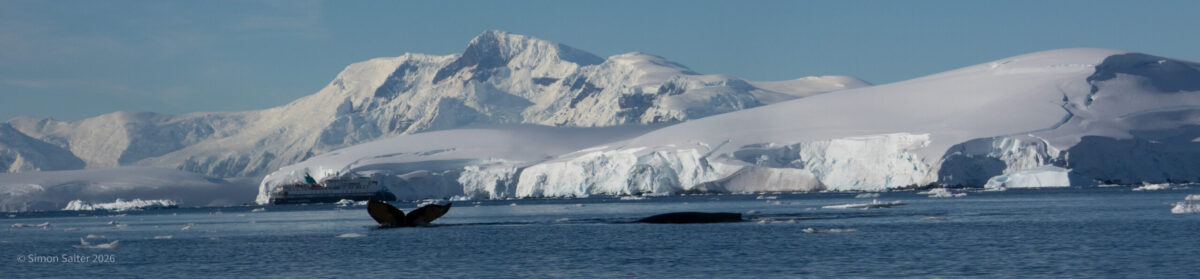
It was our last day in Antarctica and it was turning out to be a good one. For a start, the weather was beautiful. Bright and sunny. Barely a cloud in the sky. Best of all, for me, despite the brilliant sunshine, it was still cool and crisp. Perfect. In the morning we had seen more penguins than you can shake a stick at. We had seen one poor bird getting eaten by a leopard seal. There had been some great scenery, sea birds and seals. At lunch time the ship moved from Culver Island over to the much larger Anvers Island. In particular, we were at the entrance to a large bay surrounded by mountains, glaciers, snow fields and all the usual Antarctic features.


Zodiacs deployed, we all spread out around the bay. A nice feature of the Douglas Mawson is that it carries enough zodiac RHIBs that everyone can get out at the same time. No waiting for a previous group to come back in. We saw a leopard seal, calm and peaceful on an ice floe. A fur seal swam over to look at us. Then a whale popped up. And another. More whales. Whales right across the bay. As one especially enthusiastic cetacean spotter in the expedition team squealed loudly “Whale soup!”.


Several pods of humpback whales were bubble netting. The ocean just there must have been quite rich in krill. Bubble netting is a highly coordinated, cooperative feeding behaviour used to catch large amounts of krill. A group of whales works together to blow a complex, circular “net” of bubbles to trap prey, forcing them into a tight ball before swimming up through the centre to feed. Whales communicate to coordinate diving and feeding. One or more whales may act as the “driver,” while others act as the “blaster” (producing bubbles) and others as “blockers”. We could only see what was happening on the surface which was still fascinating. First thing would be a circle of bubbles forming in the water. This became more intense and then one or two humpbacks would appear, rising headfirst up through the circle. This was the first time I had ever seen the head of a humpback. More usually, you only see their backs and tails. The whole group would then bob around for a while making great blows of water vapour into the air. Finally, they would dive and, a few minutes later, another circle of bubbles would appear.


Amazing to watch although, obviously, we had to try and keep our distance. Several pods were working the bay. Flocks of birds were following each pod marking them for us. This was all we did for a couple of hours. Drift around the bay following whales. I quite unashamedly present here the greatest number of whales that I have ever photographed at one time. Extreme luck really. Right place, right time. Truly wonderful to watch and also to think that, at long last, the whales are starting to come back from decades of brutal butchery.


Reluctantly, we eventually had to head back to the ship. Then, just like that, our trip was over. Not quite, first we had to steam north through the notorious Drake Passage back to Ushuaia. As darkness fell, we were already leaving the icebergs behind. At 60° S the wind and waves can go right around the planet without encountering land. Low pressure systems whip round here, building in intensity, giving rise to ferocious waves and winds. The reputation of Drakes Passage, the gap between Cape Horn and the Antarctic Peninsula, is well earned but stems mostly from an earlier age. An age where weather forecasting was close to guessing, when vessels travelled slowly and at the mercy of the winds. Today, plans and forecasts are much more reliable. I think I have crossed these waters eleven times now and only once, back then, did we encounter really bad weather.


We spent the day packing and feeling a bit deflated. It had been a truly remarkable trip. We had seen many amazing things. Sights, sounds and sensations unique to Antarctica. For just over a month, we had been thoroughly immersed in all things Antarctic. Up until just a few years ago, I had never really entertained the idea of returning south as a tourist. Our first trip to the peninsula, over a year ago, had mostly just annoyed me. In four days, we saw a tiny bit of the peninsula at arm’s length while being herded around like senile, geriatric sheep. This time, we got a real taste of it and my itch was properly scratched. There was still a small tendency for some of the guides to be a bit superior, contemptuous and slightly patronising. For the most part though, they were friendly and informative. They treated us as equals and shared a genuine enthusiasm for Antarctica. I think a lot of this comes from the leader, Howard, who seemed like a very sincere, sociable and enormously experienced guide.
A late-night mulling over the trip was followed by an early morning disembarkation in Ushuaia. A slightly brutal and dislocating completion of the voyage but the start of something new.