
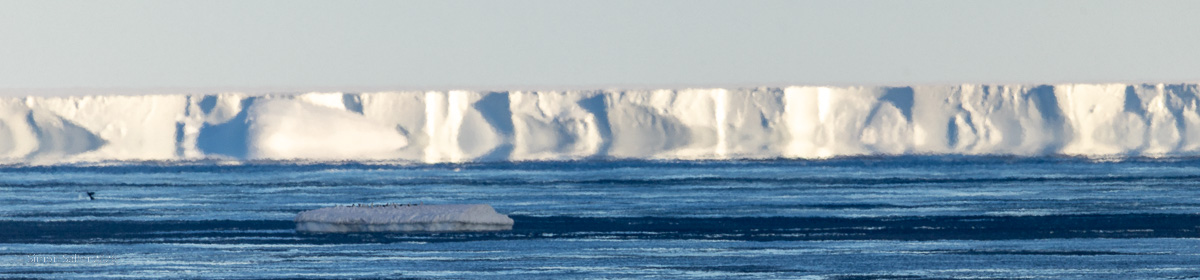
We spent the night well away from the coast. The inner channel was clogged with icebergs. The ship stayed clear of this which meant a bouncy night in the open ocean. By morning, things has settled down as we headed back towards mainland Antarctica and the Argentine Islands. The ship eased along some ice choked channels until we were close enough to put the zodiacs in for a landing.


As we work our way north along the Antarctic Peninsula, the place is feeling less and less remote. After many days of not seeing another vessel or any sign of humans, they seem to be everywhere now. Just south of Galindez Island was a cargo ship involved in resupplying the Ukrainian Vernadsky Research Base. We also came across a couple of yachts. They can find a safe mooring here where the inner channels are too shallow to allow dangerous icebergs in.


A leopard seal took quite an interest in the zodiacs. Swimming around them and bobbing up very close. At one point it appeared to be cuddling one of the boats. We later found it had bitten through one of the inflatable tubes that make up the sides of the boat. Fortunately, the hull is made of several tubes and can get along fine if one, or even more, of these is punctured. Eventually, it went off to bother some of the Gentoo penguins and we could get on with looking at some quiet, peaceful, Arctic Terns. Medium sized, pretty birds with an understated toughness. They migrate, annually, from the Arctic to the Antarctic and then back again. Following the sun. A journey of at least 40,000 km a year.


We passed by the Vernadsky Base. They were remarkably busy with cargo operations, possibly their annual re-supply. Certainly, they had no time for us. The base used to be owned by the British. Back then, it was called Faraday Base. After the collapse of the Soviet Union, Russia refused to give any of the old soviet base to Ukraine. However, Ukraine wanted to maintain a presence in Antarctica and, presumably, assert its independence from Russia. In 1992, BAS agreed to sell the old Faraday base for just £1. This gave the Ukrainians what they needed and also got BAS off the hook for the cost of disassembling the base. With good environmental practices and standards this would have been expensive. Since then, the base appears to have worked very well for Ukraine.


A Dobson Spectrophotometer used at Faraday was essential in establishing some of the baseline ozone level data that led to the discovery of the atmospheric ozone hole. The instrument was later moved to Halley Base. In 1985, a paper was published by BAS (Farman, Gardiner, Shanklin) in Nature magazine, based on data from Halley and Faraday, showing the development of the hole. This surprised a lot of people, not least the Americans. Since 1978, NASA had been launching satellites with a Total Ozone Mapping Spectrometer (TOMS) instrument on board. Re-examination of the TOMS data showed that the hole had been missed because the low readings were being filtered out by the analysis software as erroneous data. With the software recalibrated from the Halley ground-truthing readings, the enormity and seriousness of the situation became readily apparent. The importance of this discovery cannot be overstated. Within two years, the Montreal Protocol was introduced. An international agreement that froze the production and use of ozone-depleting substances at 1986 levels and set the groundwork for phasing them out entirely. Today, the protocol stands as one of the most successful international environmental treaties ever implemented. It is proof that we can fix major climate problems if we try.


Some fur seals were eyeing us suspiciously. We ignored them and went to look at some Wilson’s Storm Petrels. There was a group of these tiny birds, along with some Southern Giant Petrels feeding from something in the water. I had been trying to photograph a Wilson’s petrel for a while. They are small and fast and very flighty. They little perishers will not stay still for anyone. The giant petrels might have a 2 m wingspan and weigh over 5 kg. The Wilson’s however, come in at 40 cm wingspan and 40 g weight (think small fairy cake with gossamer wings). Properly tiny and almost impossible to spot and photograph in the open ocean. Now was my chance, while they were busy feeding. They have a tendency to dance on the water with their feet. This has caused to them being referred to as The Jesus Bird. They make a pilgrimage to land for breeding but spend most of the year, including the Antarctic winter, living and feeding deep in the ocean. Very small and very tough. So, although globally they are quite common, they are not seen all that often.


There is an even older British base a short distance from the working base. This is known as Wordie’s Hut and is a designated ancient site now. We were allowed a brief look around. Some of the kit and equipment was similar to gear I used during my time at Halley. Seems like I too am becoming an ancient monument.


On the way back to the ship we saw several groups of penguins feeding in the water. On land, a bunch of penguins is known as a colony, a rookery or, my favourite, a waddle. In the water they are referred to as a raft. They bob out of the water as they swim along so we get a raft of porpoising penguins. Gentoos are particularly prone to this sort of behaviour.


Thoroughly enjoyed your blog today, great photos as well. Keep them coming
Thanks Andrew