
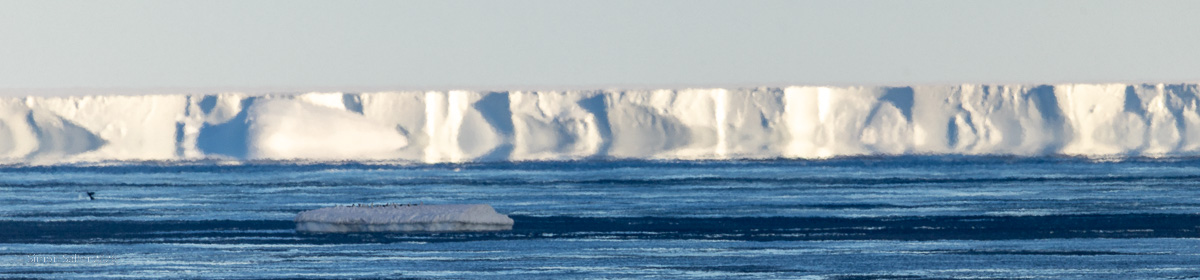
Next morning we were still in Marguerite Bay. On the east side near the peninsula. Dawn was spectacular. Clear, piercing blue sky. Bright sun. Almost no breeze. It was warm and pleasant out on deck. I spent some happy time taking photographs. In particular, I was impressed at how the mountains were encased in the sort of ice formations that you usually see in much higher peaks. Fluted faces reminiscent of the high-altitude Himalayas. Massive “rime ice” mushrooms, formed by fierce winds and moisture, typical of the great Andean peaks. The mountains here are no slouches. Many are over 2,000 m and would be extreme climbs because of the remoteness and weather conditions. To me, however, they have the character and appearance of much loftier peaks. This gives the area a sense of grandeur and magnificence.


The zodiacs were launched and we all went for a cruise. When I say “all”, I do actually mean most of the clients. There are 84 paying passengers on board and often over 80 go out on the boats at one time. Some of them in kayaks and the rest in the zodiacs. At Stonington, every single customer went ashore, all 84 of us and quite a lot of the crew. This is unusual for an expedition type cruise where there is often a significant contingent that are just along for ride. For us, it was not to be missed.


We bobbed around in the brash and small icebergs. There was a leopard seal that was not at all interest in us. Some bits of unusually clear and dense ice. The cutest baby Weddell seal and a couple more Royal shags.


Back on board, after lunch, we started steaming north and into The Gullet. Your gullet is how food gets to your stomach from your mouth (usually). Also called, the oesophagus. The Gullet is a narrow, 11 nm long, glacier-lined channel in Antarctica separating Adelaide Island from the Antarctic Peninsula. From the north, it is a scenic, ice-choked shortcut to Marguerite Bay, framed by high ice cliffs and towering mountains. It is a renowned, highly scenic, and challenging route. Obviously, our skipper was up for it. Still fresh from setting a world record for southerly navigation, he was on a roll.
We passed by Rothera Research Station. This is the main BAS base for field trips and access to West Antarctica. Unfortunately, we passed so far east of the base that very little was visible. This was a pity. I would have liked to pop in for a brew. Very slightly further north we got mugged by Killer Whales. I don’t mean they attacked us or anything, just that there were hundreds of them. Maybe not literally hundreds but certainly way more than I have ever seen before. Pods of eight or ten individuals kept swimming past us. It was amazing. I took hundreds of photographs and I do mean hundreds this time. For over an hour, we watched groups of Orca swimming south as we were steaming, very slowly, north.


After the Orca had passed behind us, we came back to embracing the incredible scenery. Occasionally, the wind would drop and the sea become calm and mirror like. Diane got extremely excited about this. She loves a good reflection and these were right up there with the best of them. It was a glorious vista. Rugged and peaceful. A brief moment of calm and solitude in a place more usually unwelcoming and forbidding. Our reverie was shattered by the sudden appearance of another ship. The SH Vega. Another cruise ship. The first other vessel that we had seen since leaving McMurdo Sound a fortnight earlier. They had come the easy way. We had come the long way round so we felt we had bragging rights. We did not come close to the Vega and before long she was disappearing behind us. Two ships passing in the early evening.


We continued through The Gullet. Squeezed past a couple of icebergs that were almost blocking the channel and eventually emerged to the north. From here, the inside passage was badly clogged with ice so we moved out to sea and had a rather bouncy night heading for the Argentine Islands.


