
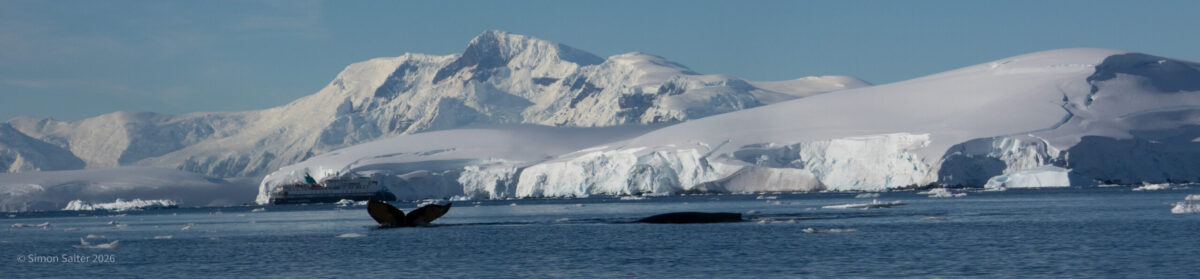
Four consecutive sea days. We needed to move well away from the coast to avoid the great rafts of sea ice that are starting to build up. At this time of year, it is too easy to get caught up in the drifting, freezing ice and, potentially, stuck. We had a ship full of Antarctic enthusiasts but even so, nobody wanted to stay here for the winter. First day out there was not much to see. Pancake ice and fog. The occasional iceberg lurking in the distance. Fortunately, the radar was undeterred by fog. Next day the visibility improved. There was very little fresh ice but way off to starboard we could catch the odd glimpse of the ice edge. We stopped for whales. A large pod of feeding humpbacks. Many people came out on deck to try and grab a photo. The passing days settled into a different rhythm. Whale watching, bird watching, lectures, films, gym sessions. Eventually, we rounded the worst of the pack ice and could head more south. At least a little way.


Peter 1st Island is a very remote and rocky island. Seldom visited. It is remote on many counts. Geographically, it is simply a long way from anywhere else. 450 km off the Antarctic coast – not that there is anything or anyone at that bit of coast. Logistically, very few vessels cross the Amundsen and Bellinghausen seas of Western Antarctica. Nobody comes this way except the odd scientist and a few lonely tourists. For most of most years, the island is usually solidly surrounded by sea ice. Locked in a deep, frigid winter. Gloriously isolated and inaccessible. Societally and historically, there is nothing here. No bases, no old huts, barely anyone has even landed here. There was a small hut once but it has long since been blasted away by the fierce storms that pass as normal weather here.
The island was first sighted by Bellingshausen in January 1821 and named after Peter 1st of Russia. A hundred years later, Larsen was the first to set foot on the island and claim it for Norway. It is small, about 10 km x 20 km, volcanic and almost completely covered by glacier.


We approached from the east. Landings had previously been made on this side. What we found was dark, steep and forbidding. The cloud was low and grey. A stiff, cold breeze made standing on deck quite unpleasantly cold. The swell was substantial. The sky was dark and ominous. We could not see more than a couple of hundred metres up the cliffs. Peering through the gloom, it was just possible to see great seracs of ice and cornices blown snow. Tons of a Damoclean ice perilously overhanging the cliffs. There was no safe place to land here.


The ship backed out and then sailed, north-abouts, to the western shore. As we rounded the northern limit, the sun came out. Above the island, the clouds were lifting. Thick, rounded lenticular clouds were forming high above us. We were greeted by the sight of more steep cliffs, now iridescent in the bright sunshine. The ship steered towards an immense slice of cake. Layers of red and black volcanic ash iced with layers of thick, brilliant white snow, névé and ice. Then the wind stuck. A fierce katabatic blowing straight off the mountains. Katabatic winds are strong, cold, gravity-driven winds that rush downslope from high-elevation ice sheets to the coast. Caused by radiative cooling, these dense, heavy air masses often reach hurricane-force speeds. The ship again backed off as the winds gusted to over 50 knots.


On the island, the cloud continued to lift. The sky was clearing elsewhere and the bright sun was actually beginning to feel warm. We moved back in, a little further north and just past a small, gravel spit, found a place to anchor. The winds had dissipated, we were shielded from the ocean swell and, at last, we could attempt a landing.


We did not land. The zodiacs were launched and we had a pleasant cruise. Close to the shore it became apparent that a general landing would be risky. There was still a significant swell and the shoreline offered very few safe places. Two of the expedition team, fully equipped with dry suits, leapt ashore and scrambled around for a few minutes. A rare landing had been made and we were part of it. Our driver took the boat in close to some cliffs. Diane reached out and touched one of the most remote places in the world. A few moments later, a small avalanche came down the wall close to where we had been. Mostly just powder snow, it would probably have been more unpleasant than dangerous. Even so, best avoided.


Back on the ship, we got warmed up. This was helped by hot chocolate drink served with Baileys. Then I was back on deck for a while, photographing the amazing icebergs as we set sail for the Antarctic Peninsula.
What an amazing trip for you, man your storytelling and the photography transported me there, incredible stuff.
Stay safe and keep it going.
Thank you