
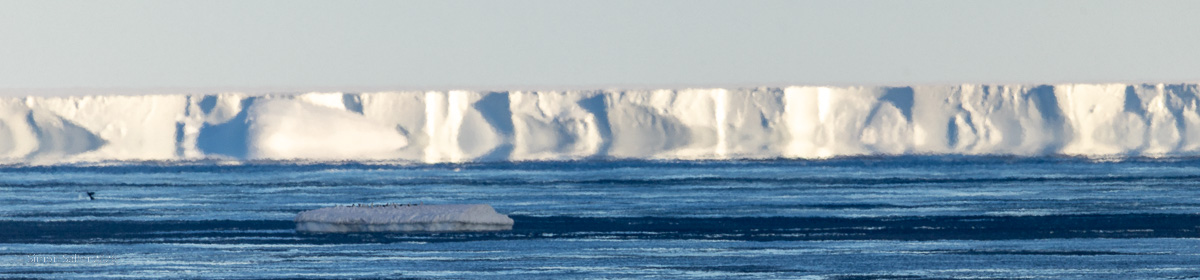
Leaving Cape Crozier, we set off along the edge of the Ross Ice Shelf. At 800 km wide, it is the largest ice shelf in Antarctica. About the same size as France. The ice edge is a vertical cliff up to 50 m high. Most of the ice shelf is floating. 90% of it is below water. Hundreds of metres thick. Sailing below the ice cliffs is quite remarkable. A single, solid, bright white line stretching from horizon to horizon. Almost featureless until you zoom right in with the binoculars. Even then it is mostly just flat white ice. Sharp and hard and unforgiving. For over two days, all we could see was this great barrier of ice.


At the eastern end of the ice shelf is an area called the Bay of Whales. This has enormous historical significance. Amundsen started his trip here when he beat Scott to the South Pole. Roald Amundsen set up his base, called Framheim, on the ice shelf and stayed here for the winter. Later, Admiral Bird, built a base called Little America in roughly the same location. There were several generations of this base. All the bases suffered the same fate. First, they got buried by snow and disappeared into the ice. Later, the ice will have broken off and the base would have disappeared down to bottom of the ocean. Sadly, despite the many iconic stories, there is nothing left to see here. Just snow, ice and seawater.


We could not even see the sea. It was freezing over. A thick layer of pancake ice and a lot of fog. Sea fog or ice fog. Caused by the sea being much warmer than the air. Outside, it had dropped to -20°C. The decks were covered by ice. So were the railings, the lifeboats and even the air intakes. A thick layer of rime ice on everything. The blocked vents caused something in the heating boilers to break. The crew were very sketchy when it came to giving us details but my guess is that some heating element burned out because of poor air supply. This is a newly built ship and quite possibly has never been somewhere this cold before. It is designed to operate in the Antarctic but that is not the same as actually testing a whole big vessel in freezing weather. We are in a Chinese built ship, registered at Nassau in the Bahamas, with a captain from Panama. What could possibly go wrong in the Antarctic?


While this drama was going on in the engine room, up on the bridge they were getting quite excited. The southern side of the Bay of Whales is a mass of shifting shelf ice which is constantly breaking off into icebergs. The shape of the navigable part of the coastline was always changing. Exactly now, it was possible to reach a point that was further south than anyone had ever sailed before. In any type of boat or ship. Obviously, the skipper found this irresistible and went for it. 78º 44.405’ S A new world record. It was reported within hours by Wanderlust magazine.
The excitement was short lived. We did not want to hang around. It would be very easy for the ship to get stuck in ice around here and our heating had just packed up. A day later, the sea surface was still covered in pancake ice but it was much thinner. We had moved well away from the sea ice that was spreading out from the coast. The outside air was still below freezing but this was 15°C warmer than in the Bay of Whales. A little life had been coaxed out of the heating system. Some parts of the ship were cold. A few passengers were moved to different cabins. Our cabin remained lovely and warm.


