
Another day, another hut. This time it was Scott’s hut on Cape Evans. Considerably larger than Shackleton’s hut at 15 m by 7.5 m. Prefabricated, well-made and well insulated with dried seaweed. Lighting was by acetylene gas. A small gas generator is by the door. I cannot find a description of how this worked. I think it will have used calcium carbide. Dripping water onto carbide makes acetylene gas. I used to have a caving lamp that worked like this. It has quite a distinctive smell but makes a good light and will have helped warm the hut as well. If carbide was used, then it will probably have been all removed by now. It is quite reactive and a build up of acetylene can be explosive.
A stable was added to the side of the hut and a utility room. Heating came from the kitchen range plus an additional stove in the officers’ quarters. While Shackleton was completely egalitarian over the layout of his hut, Scott maintained a clear class division. The hut is separated into two parts with a room divider made of packing cases. Officers and men even had separate dining tables. The hut has been beautifully restored. It looks just as it might when it was in use. Maybe not exactly the same but similar or reminiscent, anyhow. In the stable are a pile of penguins and a palette of seal blubber. The dark room has chemicals on the shelves. A harness for pulling sledges is hanging off a bunk. The kitchen looks well stocked. There is a penguin on a side table all ready for dissection and a newspaper dated 1908.


The hut was built in 1911. That winter 25 men over-wintered in it. In the early summer, 16 men set off for the South Pole. In the final push, Scott and four others made the pole but never made it back to the hut. One of many tragic and heroic stories from Antarctica. Several other trips were made from the hut. A winter trip to Cape Crozier almost ended in disaster. A northern party sailed to Cape Adare and ended up spending two winters. The second, in a snow cave where they suffered appalling conditions and extreme weather. A geological expedition went essentially to plan. However, the second trip got into trouble and were eventually rescued by ship off the sea ice.
We were told to keep our voices low when we around the hut as a sign of respect. This reminded me of when we visited the Sistine chapel in the Vatican. A guard there told me to remove my hat as a sign of respect. I was dying to ask how he knew God had a problem with hats. The guard seemed a bit stern and devoid of a sense of humour, so I kept quiet. Entry and exit to the hut was carefully controlled. We had to clean our boots. Only four at a time inside. No rucksacks. No touching. As we were leaving the hut, I really wanted to say, “I am just going outside and may be some time” but on balance it seemed better to keep quiet. Too many people looking profoundly serious.


The hut was reused in 1915 when Shackleton’s Ross Sea party got into trouble. Fortunately, the well-stocked hut provided a relatively comfortable refuge until Jan 1917 when Shackleton arrived to rescue them. The hut was untouched until 1956 when it was dug out by an American team and found to be in a remarkably good state of preservation. Since then, it has been maintained to give visitors a little insight into what life would have been like.
At Hut Point is Scott’s first hut. This was our destination for the afternoon. Hut Point is also the location of the McMurdo base run by the USA. This is, by an order of magnitude, the largest base in Antarctica. We were told that the wintering team, all 200 of them, were just settling in and could not accommodate visitors. By way of comparison, my wintering team at Halley was just 18 people. Our expedition team also found out that it was impossible to get to Discovery Hut because the remains of the sea ice formed a barrier. We sailed past McMurdo base slowly to get a good look at it. Just around the corner is Scott base. This is the New Zealand base. A modern looking base painted the same green as the hut at Cape Bird. New Zealand green. Obviously, a tiny base compared to McMurdo.


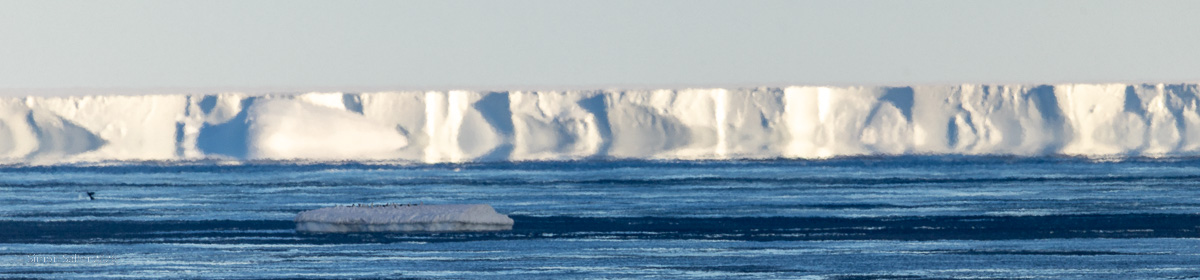
Further on we came to one of several runways. This appeared to be a thoroughly busy place. We watched an aircraft take off. As evening fell, the ship bobbed around in the pancake ice by the edge of Ross Ice Shelf. A group photograph was done here. After this we went to bed and the ship set off to sail around to Cape Crozier.


