
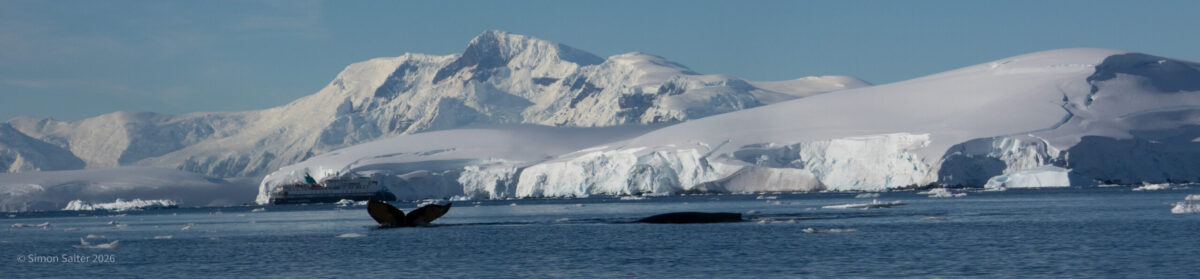
Sailing south from Macquarie Island we had a couple of sea days. Nothing much happening. Nothing much to see. I spent some time on the back experimenting with camera settings. My relatively new Canon EOS R5 MkII is a lovely camera but has way too many options. It also has way too many complex and fiddly controls to manage all the complex and fiddly options. A lot of learning is needed to master the beast. I try and take this in small and manageable slices.
Antarctica is in a state of political limbo. Slices of it are claimed by various countries. Many of these claims are overlapping. Antarctica has no permanent population, no citizenship and no government. There is no Antarctic sovereignty. Personnel present in Antarctica are always nationals of some other country. In 1959 the Antarctic Treaty was ratified by most of the countries with a stake in Antarctica. Think cold war. This was primarily an arms control agreement. It designated the continent as a scientific preserve, established freedom of scientific research and banned military activity. To date this has worked well. There have been a few minor skirmishes but the treaty serves everybody’s interests, so far, so it prevails. I worked in Antarctica 35 years ago and was always extremely impressed by international spirit of scientific cooperation it engendered. Unfortunately, in my opinion, the robustness of the treaty is like a house of cards. To date, Antarctica has only been useful for scientific research. That is changing. When I worked down south, there were no tourists. None. A half dozen brave people in yachts would visit the very northern tip of the peninsula. Last year there were 120,000 tourists. Numbering a mere 5,000, the scientific community is in the minority these days. What is more, these tourists not rough and tough hardy types. Far from it. They are mostly of the retired demographic enjoying a comfortable lifestyle. We are spotting icebergs from the bar of the observation deck while sipping a gin and tonic and nibbling a few salted cashew nuts.


The winter is still harsh. Less than 1,000 people on the whole continent and no tourists. No doubt this will change. However, I am not suggesting that tourism will be the problem. To date, the increase in visitors appears to be benign. Antarctica is uniquely vulnerable but even so, it is a whole enormous continent. 120,000 people spread quite thinly. The International Association of Antarctica Tour Operators (IAATO) is the tourism body for self-regulation. They report to the Antarctic Treaty Consultative Meeting, an annual forum for Antarctic Treaty nations to exchange information, discuss matters of common interest, and formulate measures for managing the Antarctic region. This is voluntary self-regulation. IAATO is all set up to look very official. The implication and likely ambition, is that for a tour operator to work down south they will need to be a member. Like most standards, it primarily benefits the organisations that set the standards while putting barriers in the way of aspirants. I would anticipate that getting the necessary governmental permissions to visit Antarctica is greatly facilitated by membership.
Antarctica will get into trouble at some point on the current global socio-political trajectory when technology and resource scarcity intersect. The inauguration of President Trump initiated post-truth politics. Since then, we have seen a collapse of the social growth of civilisation in favour of capitalist greed and isolationism. Events such as Brexit, the reappearance of war in Europe and Trump’s second term are points on a line that reinstates a world order based on power and nationalism. As, and when, necessary resources in Antarctica become economically viable to access, one of the superpowers will be there. No amount of waving the Antarctic Treaty documents will make any difference. While staring out of the cabin window with the gloomy thought in my head, I saw the first iceberg go past. This was much more interesting. Not far ahead was the first sea ice. A strip of loose, brash ice that had probably been floating around for a while.


Next day, we were bearing down on the Bellany Islands. A remote, uninhabited volcanic archipelago, approximately 325 km north of the Antarctic coast. Discovered in 1839, the chain, is heavily glaciated, features steep cliffs, and is rarely visited due to harsh weather and ice. We aimed for the middle of the three islands. This meant we has to cross the Antarctic circle to get there. The event was taken as an excuse for celebration. King Neptune visited the top deck. There was cheering, photographs and a toast. I avoided the nonsense and got on with trying to master the camera.
Meanwhile, as we closed in on the shelter of the islands, the wildlife began to appear. Seabirds, a few penguins standing around on ice floes and whales. A lot of whales. Mostly sperm whales, I think. Every few minutes there seemed to be another puff of water vapour from a whale blowing.


The zodiacs were put in the water and we had a short cruise between Sabrina and Buckle Islands. The wind had picked up again making the sea quite choppy. It was mere minutes before we were all soaked by salty spray. But it was worth it. There was a small group of whales feeding and we could get close to them. An intense flock of cape petrels marked the spot and every couple of minutes one or more whales would pop out of the water. Difficult to take photographs with the cold wind and the spray but an amazing privilege to watch. Back on the ship, we had a hot shower and then settled down with a glass of wine to be served an excellent meal. Such is the way of the modern Antarctic explorer.


