Britain’s last war and the official end of the world

Ushuaia is the self-proclaimed official end of the world. Their moto is Ushuaia, fin del mundo, principio de todo (Ushuaia, end of the world, beginning of everything). It is generally recognised as the southernmost city in the world. There are settlements further to the south, such as Porto Williams in Chile, but Ushuaia is only one that can genuinely claim to be a city. Interestingly, in a change since I was last there, Ushuaia also claims to be the capital of the Falklands. In recent years, the assertation that Las Malvinas son Argentinas (The Falklands are Argentinian) is becoming increasingly manifest. Signs and posters abound. There is a memorial park with plaque, statues and an eternal flame. Roads have been renamed. Our hotel was on the Heroes de Malvinas road. The Mirador Heroes de Malvinas is a layby with a pleasant view across the Beagle Chanel. Prominent billboards have been erected at viewpoints so that you can include a Las Malvinas son Argentinas message in your holiday snaps.

Presumably, Argentina is trying to up the ante, again, with regards to its territorial claim over the Falklands. I can’t help thinking that this is a little pointless. Ignoring the fine detail of the relative claims, it is clear that the UK considers its claim more than adequate. This was proven in 1982 when Argentina invaded. They were forcibly ejected a few weeks later by a UK task force. In a recent poll, 99.8% of Falklanders reported that they wanted to remain British. The Falklands is financially self-sufficient and important to the UK with regards to its operations in Antarctica. It is unclear, to me, what Argentina is hoping to achieve. An increase in diplomatic tensions is the only likely outcome and that does not seem beneficial to anyone.

We decided to spend a few days in Ushuaia. It is a interesting place. Last time we had been here we went straight to the airport from the ship. Prior to that, I had spent the best part of a week here but that was 35 years ago. Things have changed massively since then. Back then, although nearly ten years after the Falklands war, there was almost no reference to territorial claims.

We took a short drive into the Tierra del Fuego National Park. This is where the Pan-American Highway officially ends at Lapataia Bay. Here is also the end of the Andes. The vast mountain range tapers into the ocean and then reappears, much further south, as the Trans-Antarctic Mountains. A few ducks and geese accompanied us on a short walk along the edge of the bay. Then the rain started again. Fine for ducks but miserable enough to encourage us to give up and head back Ushuaia.

One of the great tourist trips in Ushuaia is to take a boat out into the Beagle Chanel. It is rich with wildlife including birds, seals and whales. Our boat was a medium sized catamaran called Anna B. It was filled to capacity. 100 people. Barely a spare seat anywhere. The morning was overcast and gloomy. We splashed out on some instant coffee in paper cups from the onboard shop and huddled around our table for a while. Then, thoroughly wrapped up against the cold and damp, we went out on deck.

There were some albatross, giant petrels, shags and dolphin gull. We approached Snipe Island quite closely which gave us an unobstructed view of the shags nesting and the lighthouse. In May, 1958 the Chileans built the first lighthouse here to aid navigation. Argentina, obviously, disputed ownership of the island. The following month, Argentina pulled down the Chilean lighthouse and built one of their own. This only lasted a few weeks before it was demolished and a second Chilean lighthouse erected. Next day, in a fit of pique, the Argentinian destroyer ARA San Juan razed the building with its main guns. They then landed a company of naval infantry to occupy the island and assert their claim.

The dispute simmered for 20 years. In 1978, Argentina developed Operation Soberanía, a plan to invade all the Chilean disputed territories. Chile pre-empted the invasion and placed troops on Snipe and other islands to the south. In 1984 Argentia held a referendum on the disputed territories around the Beagle Channel. The motion to recognise Snipe, Picton, Lennox and Nueva islands as being Chilean territory was carried by an 84% vote. The following year, a treaty was put in place marking the end of disputes over the Beagle Chanel.

We continued east past Peurto Williams and past Isla Gable. On a small spit of land, we spotted a dead whale being enthusiastically recycled by some giant petrels. Further on we came across the steel hulled, three masted barque called Europa. Previously, we had seen this rather lovely ship at the Argentine Islands down on the Antarctic Peninsula.

Our catamaran pulled right into the beach at the east of Isla Gable. There are many seals and penguins here. We spotted Gentoo penguins along with a few Magellanic penguins. I think most of the seals were South American Sea Lions.

There were also a few Turkey vultures. Obviously, they have their place in the world but this comes with the sort of face that only a mother could love. Much more elegant was a juvenile Southern Crested Caracara although its diet is similar. Nice looking bird but don’t look too closely at what it is eating. There were more shags and giant petrels. In all, an impressive gathering of birds and animals.

Several other boats arrived and proceeded to disgorge their passengers onto the beach. Here, the tourists mixed freely with the sea lions and penguins. This all seemed a little too invasive to me. People were very clearly disturbing the birds and animals. We were under strict instructions to stay on the boat. I think this was the more appropriate option.

One more day in Ushuaia and we drove north over the Garibaldi Pass. Wonderful mountainous country. We explored a few tracks. Needed to be a bit careful because we only had a very ordinary hire car. Nonetheless we found some lovely lakes, forests and hills. We discovered a beaver dam. This was all set up with a picnic area and a viewing place. We spent a while hoping to see a beaver but nothing. I did spot a Night Heron that was rather striking. For our last night, we treated ourselves to a meal at the hotel complete with an over-priced bottle of wine. Tomorrow we were flying to El Calafate.

Two islands, instant whale soup and a reluctant departure from the most amazing place in the world

It was our last day in Antarctica and it was turning out to be a good one. For a start, the weather was beautiful. Bright and sunny. Barely a cloud in the sky. Best of all, for me, despite the brilliant sunshine, it was still cool and crisp. Perfect. In the morning we had seen more penguins than you can shake a stick at. We had seen one poor bird getting eaten by a leopard seal. There had been some great scenery, sea birds and seals. At lunch time the ship moved from Culver Island over to the much larger Anvers Island. In particular, we were at the entrance to a large bay surrounded by mountains, glaciers, snow fields and all the usual Antarctic features.

Zodiacs deployed, we all spread out around the bay. A nice feature of the Douglas Mawson is that it carries enough zodiac RHIBs that everyone can get out at the same time. No waiting for a previous group to come back in. We saw a leopard seal, calm and peaceful on an ice floe. A fur seal swam over to look at us. Then a whale popped up. And another. More whales. Whales right across the bay. As one especially enthusiastic cetacean spotter in the expedition team squealed loudly “Whale soup!”.

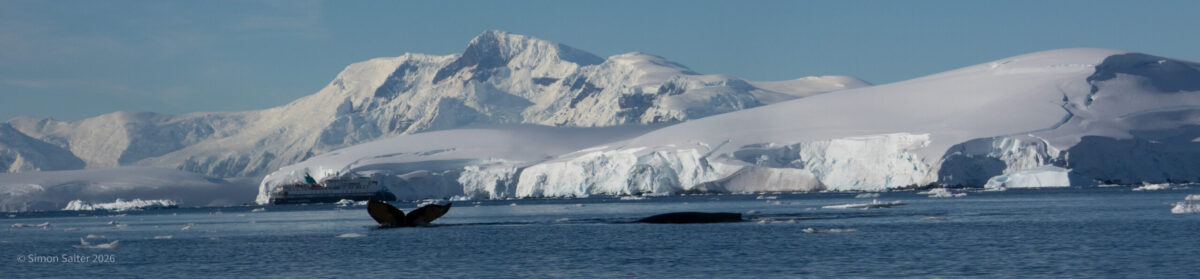
Several pods of humpback whales were bubble netting. The ocean just there must have been quite rich in krill. Bubble netting is a highly coordinated, cooperative feeding behaviour used to catch large amounts of krill. A group of whales works together to blow a complex, circular “net” of bubbles to trap prey, forcing them into a tight ball before swimming up through the centre to feed. Whales communicate to coordinate diving and feeding. One or more whales may act as the “driver,” while others act as the “blaster” (producing bubbles) and others as “blockers”. We could only see what was happening on the surface which was still fascinating. First thing would be a circle of bubbles forming in the water. This became more intense and then one or two humpbacks would appear, rising headfirst up through the circle. This was the first time I had ever seen the head of a humpback. More usually, you only see their backs and tails.  The whole group would then bob around for a while making great blows of water vapour into the air. Finally, they would dive and, a few minutes later, another circle of bubbles would appear.

Amazing to watch although, obviously, we had to try and keep our distance. Several pods were working the bay. Flocks of birds were following each pod marking them for us. This was all we did for a couple of hours. Drift around the bay following whales. I quite unashamedly present here the greatest number of whales that I have ever photographed at one time. Extreme luck really. Right place, right time. Truly wonderful to watch and also to think that, at long last, the whales are starting to come back from decades of brutal butchery.

Reluctantly, we eventually had to head back to the ship. Then, just like that, our trip was over. Not quite, first we had to steam north through the notorious Drake Passage back to Ushuaia. As darkness fell, we were already leaving the icebergs behind. At 60° S the wind and waves can go right around the planet without encountering land. Low pressure systems whip round here, building in intensity, giving rise to ferocious waves and winds. The reputation of Drakes Passage, the gap between Cape Horn and the Antarctic Peninsula, is well earned but stems mostly from an earlier age. An age where weather forecasting was close to guessing, when vessels travelled slowly and at the mercy of the winds. Today, plans and forecasts are much more reliable. I think I have crossed these waters eleven times now and only once, back then, did we encounter really bad weather.

We spent the day packing and feeling a bit deflated. It had been a truly remarkable trip. We had seen many amazing things. Sights, sounds and sensations unique to Antarctica. For just over a month, we had been thoroughly immersed in all things Antarctic. Up until just a few years ago, I had never really entertained the idea of returning south as a tourist. Our first trip to the peninsula, over a year ago, had mostly just annoyed me. In four days, we saw a tiny bit of the peninsula at arm’s length while being herded around like senile, geriatric sheep. This time, we got a real taste of it and my itch was properly scratched. There was still a small tendency for some of the guides to be a bit superior, contemptuous and slightly patronising. For the most part though, they were friendly and informative. They treated us as equals and shared a genuine enthusiasm for Antarctica. I think a lot of this comes from the leader, Howard, who seemed like a very sincere, sociable and enormously experienced guide.

A late-night mulling over the trip was followed by an early morning disembarkation in Ushuaia. A slightly brutal and dislocating completion of the voyage but the start of something new.

Iguazu

The Iguazu falls on the border of Argentina and Brazil are the largest waterfalls in the world. The highest part, known as the Devil’s throat, is some 80 m wide and about as deep. The falls have featured in many films including Indian Jones, James Bond and Captain America. Understandably the falls are a bit of a tourist attraction. Controlled access is from both the Brazilian and Argentinian sides.

We arrived at the border city of Puerto Iguazú in the evening. The area is classified as Humid sub-tropical and surrounded by rainforest. Our hotel, the Mercure, was rather pleasingly set in a forested area outside the city. Our room on the second floor had a balcony that looked straight into the jungle. We could sit there and watch parrots, monkeys, lizards and many types of bird. Early evening a few fireflies came out. Brilliant.

Once upon a time, the Iguazu falls were deep in the jungle. Remote and difficult to access. Now they are part of a theme park. In some ways this reminded me of the remarkable Postojna cave in Slovenia. A magnificent natural phenomena that has been harnessed and tamed and turned into an item in a display case. In each case, millions of dollars have been spent to create a tourist attraction that will generate tens of millions of dollars. In each case, it feels to me, like much of the natural aspect has been lost. No doubt the owners will talk about preserving the environment and improving accessibility. They will point out that the tourists will come anyhow and there is a need for control. They will probably be less inclined to mention how much money they have made out of it.

Anyhow, we had no choice in the matter, so we queued to get into the carpark. Then queued to buy our entrance ticket, queued to get a train ticket and finally queued to board the train. Such is the joy of being a tourist. Two train rides later we started the walk along the raised footway to the Devil’s Throat. We had already passed innumerable cafes and souvenir shops. We’d also fought off people wanting to be our guide and those selling additional experiences such as boat rides. The footway was a bit of a pain because it was so crowded with people. Took us about half an hour to get to the viewing platform. Then another good ten minutes to actually get on the platform and to a position where we could see something. It was also very hot and humid. The net effect of all these factors pretty much meant I was ready to leave before we had finished arriving. But I persevered for the sake of a few photos. Fortunately, I am a bit taller than many of the people that were around us. Although I resisted the temptation to rest my telephoto lens on the head of the person pushing in front of me.

The park is arranged into a series of pathways that form loops. Each is an hour or two long. Having achieved the big ticket item, Devil’s Throat, we had a break for over priced coffee and a cheese empanada that turned out to have ham in it. You are encouraged not to feed any of the animals especially the persistent coati and monkeys. Many of the cafes have a caged area outside where you can eat in safety. Empanada in the animal proof bin, we managed to buy a soggy and tasteless mixed veg sandwich and then tackled another loop of raised walkways.

The second loop took us around some other parts of the falls. The walkways were as crowded as ever but some of the views were pretty good. The train back to the car park was especially crowded and required a queue of over half an hour. By the time we got back to the car we were both dragging our feet a bit.

Next day we had a choice. The original plan was to drive to the Brazilian side. This was starting to lose its appeal. A long drive and more queues. Staying with the Argentinian side was a shorter drive and we just had one more loop to walk around. We had started late and still felt tired from the day before, so we decided to stick with the devil we knew. This had the tiny bonus of a reduced entry fee. Not unsurprisingly, the day was much of the same. We kept it shorter and less demanding. The final, lower loop, possibly gave some of the best views of the weekend but the weather remained stubbornly hot and humid.

After our third night in the jungle hotel, we set off back to Buenos Aires. The drive was uneventful. The Argentinian company “Five Senses Travel” organised this trip for us and did an excellent job of it. Very friendly, helpful and knowledgeable. I would recommend them if you are ever out this way. Two hotels later we were at BA airport checking in our bags for the flight to Lima.

Esteros del Iberá

The hire car was a small Toyota. It was adequate and easy to drive. We headed north away from the conurbations of Buenos Aires and out into the countryside. This part of our trip had been organised by a company called “Five Senses Travel” https://fivesensestraveller.com/ . We like to be able to explore on our own a little. Sometimes organised tours are just all about an idea of what tourists want to see. Tourists want to visit tourist attractions. Well, sometimes. Often, we really enjoy seeing the ordinary towns and countryside. Seeing how people live, what they grow, how they go about their daily lives. Getting to know a country rather than just focusing on the spectacular and unusual. Driving can be a wonderful way to do this. We had a couple of weeks. We wanted to drive around Argentina a bit and we wanted to visit the Iguazu waterfalls – which are a tourist attraction. Five Senses put together an itinerary which started with Soledad, our guide in BA and ended back at the airport ready for the next leg of our journey. The first part was just a few hours driving to Concepción del Uruguay – which is not in Uruguay but is on the river that borders Uruguay. We found a nice beach by the river.

Two days later we arrived at a hotel in a swamp. El Transito Hotel Boutique is right in the middle of the National park of Esteros de Ibera. Wikipedia describes this area as a mix of swamps, bogs, stagnant lakes, lagoons, natural slough, and courses of water. We were not too sure what to expect. Getting there involved some off-road navigation. The little Toyota struggled a little but what really grabbed my attention was the large variety of birds sat on the fences and posts by the roadside. We arrived mid-afternoon at the hotel which was set in the middle of an immense and carefully mowed area of grass. Rheas were running around to one side and we also saw a fox.

After a very welcome glass of wine, we were invited to go on a trip with a boat and horse to see the sunset. Sounded fun so they equipped us with rubber boots and off we went in a land cruiser. Ten minutes away we hopped out of the car and our two guides led us past a wooden house and through some muddy bog to a small boat. Here we met a very strong and capable looking man dressed in the style of a gaucho. He got the four of us into the small boat and then pushed it for a few minutes along a water channel. He left us there for a short while and then reappeared on his horse which he tied to the front of the boat.

Off we went. Me, Diane and two guides in a small boat being pulled by a man on a horse. The water got deeper but the horse did not seem to care and plodded on with water sloshing around the saddle. It was a delightful way to travel and felt quite in tune with the surroundings. We pushed through narrow, weed choked channels and through small pond areas. Our gaucho, or at least his horse, knew exactly where to go and where was safe to walk. Half an hour or so of this brought us to a wooden hut with a table, an immense old tree and a lovely view. Our guides magicked up some coffee and cakes while we lazed around and took in the vista. The trip back was similar but with the addition of the perfectly timed and spectacular sunset. Dinner was waiting for us on our return. Excellent home cooked food and a glass of wine. It was starting to look like life in the swamp was not too bad.

9am in the morning we were breakfasted and ready to go. A short drive in a different direction took us to our waiting horses. Neither of us have any equestrian inclinations at all but we had been assured that this was not a problem. They had even brought some steps to help us mount. The horses turned out to be very placid and ideally suited to slightly nervous complete beginners. Two different guides this morning. Neither of whom spoke any English. This did not cause a problem fortunately. The essential message was clear. Get on the horse and follow them. We were in a different part of the wetlands now. Far less of the tall grass that we saw the previous night. It was still swamp though. We set of down a dry track but within a few hundreds of metres our horses were clip, clopping through water. From the higher vantage point of being on horseback we could see more birds and wildlife. Just after we set off there was a Capybara. These are large rodents. The largest of all rodents. A bit like giant, short haired Guinea Pigs but weighing in at 50 kg or more.

We plodded through the swamp for an hour or so. It was lovely. Peaceful and relaxing. At one point the water go deeper. We ended up with water at saddle height. The horses did not seem to mind and stayed gratifyingly sure foot even in a metre or more of water. Eventually, we ended up at a place way out in the middle of the swamp. Almost completely featureless. Flat and wet and swampy in all directions. There was not really any point in getting off here so instead we turned around and headed back. I enjoyed the ride but was also happy to get back. My legs were just starting to tell me I had sat on the horse for long enough.

After a very pleasant and relaxed lunch back at the hotel, I set off to photograph some of the wildlife that was running around outside. A fox was the first thing I found. Apparently, several families live close to the hotel and you need to be careful about leaving things outside. They have a liking for stealing shoes. The hotel swimming pool proved to be ideal twitching country. There were some herons here standing very still. The pool is natural spring water, so I imagine the lack of chlorine makes it more inviting for the birds. I also spotted a couple of small birds that I needed to identify later. I am far from being a proper bird nerd so anything I don’t recognise; I look up with Google Eye later. This almost certainly gets some of the birds wrong. Sorry, I tried. Final birds for the after lunch spot were some Rheas. Immense great ostrich like birds running around on the lawn.

Next trip was on a pontoon boat. Two hulls with a large, circular sofa on top and an engine. Very comfortable for cruising round a swamp. Almost as soon as we set off, we spotted a caiman. A large and rather scary looking alligator type thing. First, we spotted them lying around on the bank but then later we saw them in the water. They can sink low in the water so that just their eyes and nostrils are about the water. I was glad we had not encountered any caiman while we were on horseback. We cruised for about an hour. It was fascinating. There were so many different types of birds that I found it hard to keep up with them. We also spotted a large, male marsh deer and loads more capybara.

Eventually we arrived at a large open area close to a densely forested island. Here we stopped the motor and floated around for a while enjoying the sights and sounds. Once again, our guide brought out some food and coffee. Little cakes and cassava bread with cheese. Everything was orchestrated around the sunset. The sun played its part magnificently and we were treated to colourful orange skies as we headed homeward. We arrived back at the little quay just after the sun had dipped below the horizon. From there it was just a short drive back to the hotel and another excellent home cooked meal. On the way we spotted some very young capybara with their mother.

Next morning I spotted a great big lizard on the way to breakfast. An Argentine black and white tegu I later discovered. A good metre long. He was not particularly disturbed by me and carried on looking for his breakfast while flicking out his long, forked tongue. We did eventually leave and took a leisurely drive back along the track while I tried to photograph some of the birds by the roadside. These included a Caracara bird, an owl, several finches and an egret.Back on to tarmacked roads and we set a course for the Iguazu waterfalls.

Buenos Aires

We were bundled off the Amundsen early on a Thursday morning and by the evening we were settled into our hotel in Buenos Aires. Next day I spent a lot of time uploading files. The internet provision on the Amundsen is a bit limited. My specific problem was that I could not back up my photographs. This was a bit of a concern and I was much more comfortable later on when everything was safely copied away. That done, we went for a stroll. Buenos Aires is a big, modern bustling city. We are not connoisseurs of cities but we quite liked BA. After a bit of pottering around we ended up in a street café. Here we could drink wine while different couples danced tango on the pavement.

Next morning we met up with Soledad, our guide for the day. She took us on a six-hour walking tour of BA. It was not six hours of continuous walking. There were a couple of coffees as well. Even so, it was long and informative day.

We saw an awful lot of BA. There is a great diversity of architecture much of which is inspired by Europe. Some areas are very similar to Paris and Madrid. Elsewhere are some very modern buildings and bridges. We walked through a lot of history. The war of independence from the Spanish, numerous skirmishes with the English, Portuguese and others. More recently came various revolutionary movements, the 1976 coup, the dirty war and the silent marches of the mothers of the 30,000 desaparecidos (people kidnapped and killed by the military during the years of the junta). We steered clear of any mention of the Falklands although we saw many signs proclaiming “Las Malvinas son Argentinas”.

Soledad was remarkably informative. I paid attention as best I could but please don’t ask me questions later. The weather was perfect. Warm without being too hot. We wandered through several parks and everywhere the jacaranda trees were blooming with bright purple flowers. Coffee was taken at a fabulous old building with dark wood panelling, marble floors and gold inlaid plasterwork. We visited a tourist area. Shops selling fridge magnets and scarves, many burger stalls and more street tango. Several churches, city squares and a river later we got to the end of our walk by which time Diane and I were plenty ready for a glass of cold wine.

Next day we collected a hire car and set off for the famous Iguazu waterfalls.